


This week’s briefing report informs us that technology law sanctions are becoming less forgiving. This briefing report encompasses cybercrime policing, AI in legal practice, predictive government, student AI bans, data transfers, and prediction markets ban.

Newsletter Edition 98
🔥 This edition includes important updates and news in technology law from the Middle East and North Africa (MENA), Argentina, Germany, the UK, and the US. Access the latest opportunities, including remote jobs in technology law, free courses, events, and scholarships.
This Week in Technology Law:
1. Interpol’s Operation Ramz: Interpol’s four‑month operation across 13 Middle East and North Africa nations from October 2025 to February 2026 led to 201 arrests, 382 additional suspects, 3,867 identified victims and the seizure of 53 servers. The coordinated effort targeted phishing, malware and online scams.
2. Argentina’s ‘Social Digital Twin’: Argentina’s Ministry of Human Capital unveiled a “Digital Twin” project to model national poverty, subsidies and human capital scenarios using large data sets. Officials claim the AI digital twin will guide anticipatory social policy.
3. Berkeley Law bans AI for student work: UC Berkeley Law’s new policy forbids students from using AI tools to conceptualise, outline, draft, revise, translate or edit any work submitted for assessment.
4. Case Note - Munich Higher Regional Court, Decision of 11 May 2026: A Facebook and Instagram user sued Meta Platforms in the Ingolstadt Regional Court, alleging that from 16 July 2020 onward his personal data had been unlawfully transferred to the United States and shared with U.S. authorities.
Lead Story
Operation Ramz Cybercrime Crackdown
The Middle East and North Africa (MENA)
Between October 2025 and February 2026, thirteen countries joined forces under Interpol’s Operation Ramz. This four‑month campaign focused on phishing‑as‑a‑service platforms, malware distributors and online scam networks, culminating in 201 arrests and the identification of another 382 suspects.
Investigators seized 53 servers and shared nearly 8,000 pieces of intelligence across participating jurisdictions.
The operation identified 3,867 victims and uncovered infrastructure in Algeria, Bahrain, Egypt, Iraq, Jordan, Lebanon, Libya, Morocco, Oman, Palestine, Qatar, Tunisia and the United Arab Emirates.


By pooling resources and intelligence form the MENA countries,
Police dismantled a phishing‑as‑a‑service operation in Algeria, confiscating servers, computers and mobile devices.
Moroccan officers seized hard drives containing banking data and phishing software.
In Oman, a server hidden in a private residence contained sensitive information and was taken offline.
Qatar uncovered compromised devices whose owners were unaware their computers were being used to propagate malware.
Perhaps the most alarming discovery occurred in Jordan where fifteen people running financial‑investment scams were themselves victims of human trafficking. They had been lured from Asia with bogus job offers, had their passports taken and were forced to participate; investigators arrested two suspected organisers.
Operation Ramz demonstrates the value of transnational cooperation in addressing cybercrime.
Cybercrime schemes often span jurisdictions, making unilateral enforcement ineffective. Shared intelligence and simultaneous raids increase the likelihood of arrests, preserve evidence and disrupt infrastructure.
The operation also raises complex legal questions. Courts will have to determine how data was collected, whether warrants justified server seizures, and whether evidence from private cybersecurity firms is admissible.
Human‑trafficking victims forced into fraud present further challenges; prosecutors must reconcile their criminal involvement with the duress under which they acted.
Interpol emphasised that cybercrime is borderless and only an equally borderless response can work.
As phishing kits, malware and social‑engineering scams proliferate, law‑enforcement agencies worldwide will need to build on this model of collaboration.
Operation Ramz also highlights the importance of transparency; victims deserve to know how evidence was collected and how their data may have been compromised.
Legal frameworks must evolve to balance the need for international cooperation with privacy, due process and the rights of those compelled into criminality.
The success of Operation Ramz shows what coordinated action can achieve, but also clarifies the necessity of clear legal standards for digital evidence and human rights considerations.
Technology Law: Updates and Developments
Argentina’s AI Social Digital Twin
Argentina’s government announced a “social digital twin” to model the impact of welfare programmes and other policies.
The Ministry of Human Capital said the project will use large‑scale datasets to simulate scenarios involving poverty, subsidies and labour trends in order to inform policymaking.
President Javier Milei promoted the initiative on social media as a paradigm shift towards data‑driven governance, claiming it would transform information into predictive capacity and strategic design for public policy.


According to officials, the system will draw on data from state agencies and private sources, correlating variables to identify problems and forecast the likely effects of interventions.
The announcement triggered immediate scrutiny. Opposition lawmakers filed formal requests in Congress seeking details about the project’s legal basis, the scope of data collection and the safeguards for personal information.
The promotional video announcing the Gemelo Digital was quickly mocked for basic language errors. At 0:35, one graphic read “MULTIPLES FUENTES”, omitting the required accent in “múltiples.” At 0:54, a full-screen claim called it the “PRIMER SISTEMA QUE AYUDA PREDICIR EL FUTURO,” missing “a” before the verb and misspelling “predecir” as “predicir.”
Critics noted that the promotional materials were vague and raised concerns about potential involvement by Palantir Technologies, a data‑analytics company whose founder Peter Thiel had recently visited Argentina and met with the president.
Digital‑rights groups argued that merging welfare, health, judicial and education records into a single model could lead to profiling and discriminatory decision‑making. They demanded clarity on which datasets would be used, how they would be anonymised, and whether individuals could consent or opt out.
The government insisted that only aggregated and anonymised data would be processed and said the initiative is still at an early stage.
Without a transparent regulatory framework, simulation tools that promise efficiency could morph into pervasive surveillance. Argentina’s social digital twin encapsulates both the promise of AI‑assisted policy design and the perils of insufficient data‑governance.
Moving forward, public debate should focus on ensuring that predictive governance remains accountable governance, with clear procurement rules, independent audits and enforceable rights for individuals affected by algorithmic decisions.
UC Berkeley Law Bans Students From Using AI
The University of California, Berkeley Law School unveiled a sweeping rule governing students’ use of AI. Effective this summer, the AI policy prohibits students from using AI to conceptualise, outline, draft, revise, translate or edit any work submitted for credit.


It also forbids students from uploading assignments, readings, slides or class recordings into generative systems.
AI may be used solely for identifying sources such as cases, statutes or secondary materials, and students remain fully responsible for the accuracy of their research. Citations to nonexistent sources create a presumption of prohibited use.
Exceptions exist for courses specifically designed to teach AI fluency or where instructors obtain written approval to deviate from the default ban. Chris Hoofnagle, Faculty Director of the Berkeley Center for Law & Technology, explained that the AI policy aims to preserve cognitive skills central to legal education rather than to vilify AI.
Previous guidelines permitted certain AI‑assisted corrections, but the rapid expansion of generative AI models prompted a reassessment.
The ban covers activities like brainstorming topics, proposing paper structures, drafting summaries of legal rules, identifying repetitive passages, polishing grammar, generating exam outlines and translating work.
The AI policy acknowledges that lawyers must eventually be conversant with AI. Many law firms already use generative tools for discovery and research.
However, UC Berkeley Law contends that students must first learn to think critically before leveraging automation; good lawyering requires “cognitive skills necessary to strategically deploy the technology”.


The school’s strict position has sparked online conversations. Supporters argue that it will protect academic integrity and prevent “AI slop,” while critics worry it may leave graduates less prepared for AI‑rich practices.
The policy’s carve‑outs may mitigate some concerns by allowing experimentation under faculty supervision.
Other law schools will watch closely to see whether such restrictions become a broader trend in legal education.
SRA Referrals for AI‑Generated Authorities
On 14 May 2026, His Honour Judge Grimshaw referred two solicitors, Kossar Qureshi and Mahmood Hussain, to the SRA after they submitted documents containing AI‑generated citations.
Hussain, a consultant at AML Legal in the West Midlands, told the court that a paralegal had helped prepare the materials; he acknowledged that he should have verified the research.
Qureshi, director of the firm, signed off on the email filing the bundle. The case, Rodney v Gee’z Micro Bar & Pitstop, involved an application for permission to appeal. The supporting documents contained incorrect case citations that appeared to have been generated by AI.
Judge Grimshaw said the growing use of AI and false authorities threatens the integrity of the justice system and called for judges to adopt a robust approach.
He described the behaviour as inexcusable and said admonishment alone would be insufficient. The skeleton argument looked as though it had been generated by AI, with phrases like “Relevance: your client was a litigant in person,” suggesting automated drafting.
Hussain accepted responsibility for the oversight and admitted that summaries from electronic research tools should have been checked before submission. Qureshi conceded she did not draft or supervise the original documents but acknowledged the seriousness of the lapse. The judge noted failures both by the individual solicitors and by firm management.
The risks of incorporating AI into legal practice without robust quality control will always exist.
Submitting fabricated authorities undermines trust in court processes and may lead to sanctions.
Regulators (such as the SRA) will need to balance accountability for lawyers with the recognition that many research tools now integrate AI.
Firms should implement protocols requiring cross‑checking of AI outputs and transparent disclosures when generative tools are used.
The SRA’s investigation may prompt further guidance on acceptable uses of AI in court submissions and stricter penalties for negligence.
Bar Standards Board Guidance on AI and Other Technologies
The Bar Standards Board (BSB) issued comprehensive guidance on the adoption and use of artificial intelligence and other technologies to ensure barristers meet ethical and practice‑management obligations.
The document, effective 18 May 2026, acknowledges that AI can improve practice management and client service but emphasises the need for preparation.
It organises responsibilities by stages:
general ethical considerations,
competence and training,
procurement,
management procedures,
duties when using AI and oversight of AI used by others.
Under “general ethical considerations,” the guidance reminds barristers of core duties to provide competent service (Core Duty 7), act in the best interests of clients (Core Duty 2), and maintain honesty and integrity (Core Duty 3).


It states that practitioners must maintain a sufficient understanding of AI to detect errors, preserve legal professional privilege and ensure accuracy when using AI tools.
Transparency is critical; barristers must disclose their use of AI when it materially affects the nature of services and ensure they do not mislead clients or the court. Because using AI amounts to outsourcing, lawyers remain personally responsible for any inaccuracies introduced by the tools.
The guidance emphasises competence and training. Barristers should obtain ongoing education on AI to understand benefits, risks and evolving legal standards.
When procuring AI systems, law chambers must establish governance frameworks, ensure confidentiality and data‑processing responsibilities are met, and adjust data policies accordingly.
The document advises record‑keeping, including maintaining AI audit logs and prompt histories, and adopting an AI policy covering acceptable uses and governance.
The BSB’s approach recognises that AI adoption is inevitable but must align with professional duties. This guidance may inform similar policies across the legal sector.
Barristers who disregard these standards risk disciplinary action, especially as courts and regulators become more attentive to AI‑related errors. Ultimately, the guidance encourages practitioners to view AI as a tool that requires careful management, rather than a substitute for professional judgment.
Minnesota’s Ban on Prediction Markets
Minnesota enacted the United States’ first law expressly banning online prediction‑market platforms, a move that sets up a conflict with federal regulators.

The Bill makes it a crime to host or advertise a system allowing wagers on future outcomes—ranging from sports and elections to entertainment and world events.
It extends the prohibition to services that help people circumvent location restrictions, such as virtual private networks.
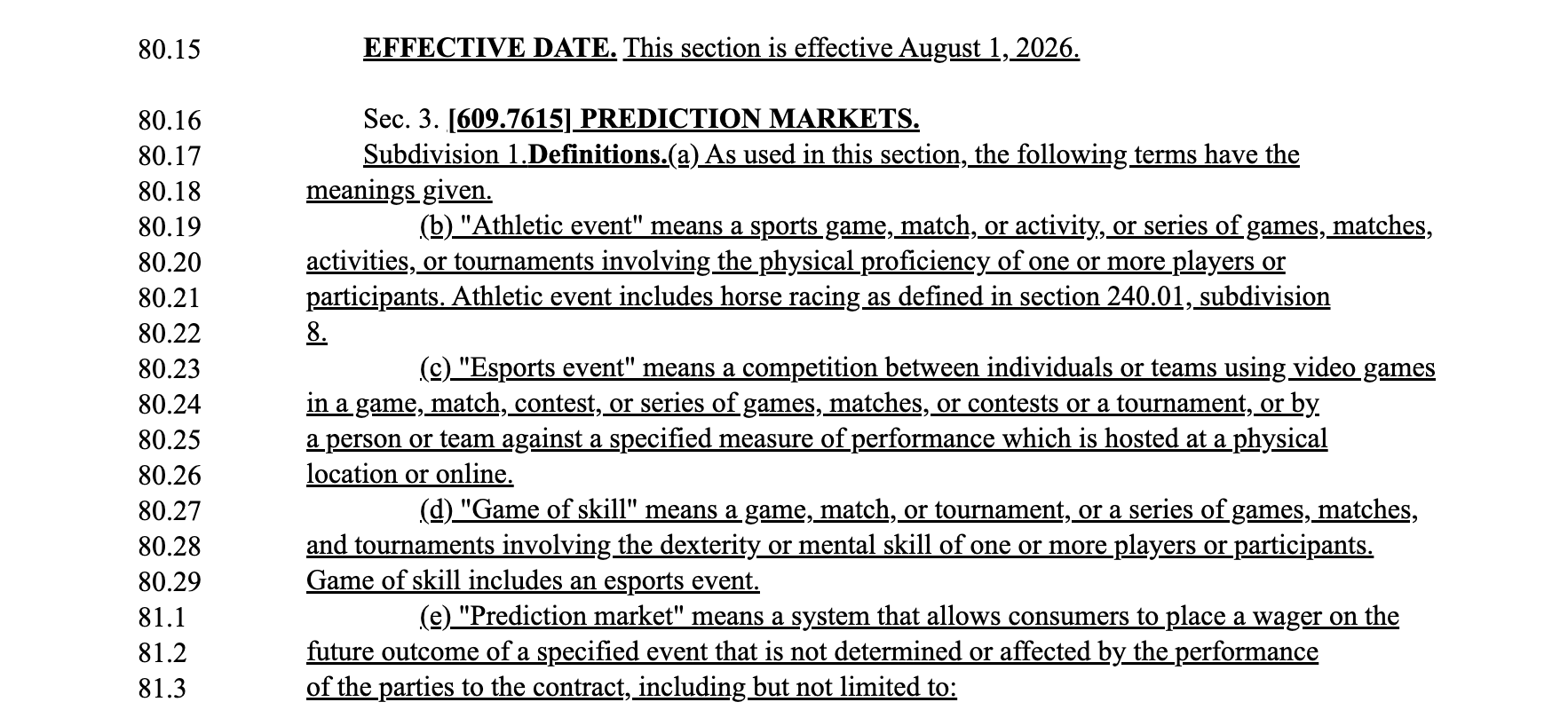
Sites like Kalshi and Polymarket must cease operating in Minnesota or face felony charges when the law takes effect in August.
Lawmakers crafted the ban to protect residents, especially minors, from gambling risks. Representative Emma Greenman, who sponsored the measure, argued that the state should decide how to regulate wagering to safeguard public safety.
The law includes exceptions for event contracts used as insurance or for trading commodities and securities.
Critics contend that the prohibition is overly broad and will drive prediction‑market activity offshore or into unregulated spaces. The
Commodity Futures Trading Commission (CFTC) has already filed a federal lawsuit seeking to block the law, asserting exclusive jurisdiction over prediction markets.
CFTC Chairman Michael Selig argued that the state ban turns lawful operators and participants into felons overnight and undermines legitimate hedging activities used by farmers and businesses.
According to the National Conference of State Legislatures, at least 14 other states are considering similar measures.
We should predict a protracted battle over whether states or federal agencies should regulate prediction markets. Most trading on these platforms relates to sports betting, which will further blur the distinction between financial instruments and gambling.
Minnesota’s law may thus become a test case for the future of event‑based trading and the scope of federal pre‑emption.
Case Note
Case: Munich Higher Regional Court, Decision of May 11, 2026
Citation: Case No. 21 U 3882/25 e, 21st Civil Division | REWIS RS 2026, 2815
Facts and Dispute
A Facebook and Instagram user sued the operator of the social networks (now Meta Platforms) in the Ingolstadt Regional Court, alleging that from 16 July 2020 onward his personal data had been unlawfully transferred to the United States and shared with U.S. authorities.
He sought damages, injunctive relief, a declaratory judgment, disclosure of information and reimbursement of legal costs. The trial court dismissed the action, and the plaintiff appealed to the Munich Higher Regional Court.
The appellate court issued an order indicating its intention to dismiss the appeal under § 522(2) of the German Code of Civil Procedure because the appeal had no prospect of success.
Legal Issue and Court’s Analysis
The primary issue was whether transfers of user data from the EU to the U.S. violated the General Data Protection Regulation (GDPR) in light of the Court of Justice of the European Union’s Schrems II decision, which invalidated the EU–U.S. Privacy Shield.
The plaintiff argued that the defendant lacked a legal basis for transfers after July 2020 and that standard contractual clauses were insufficient.
The court noted that although Article 45 GDPR was unavailable after the Schrems II ruling, Article 46 GDPR (standard contractual clauses) provided a valid basis for transfer, and Article 49 GDPR could also justify transfers where necessary for contract performance.
The court emphasised that the defendant used both the 2010 and 2021 standard contractual clauses and adopted supplementary measures such as encryption and minimisation.
The plaintiff failed to contest these measures during the trial.
The court observed that an adequacy decision under the EU–U.S. Data Privacy Framework entered into force on 10 July 2023, rendering data transfers to the U.S. lawful.
It added that the defendant also could rely on the exception for transfers necessary to perform the contract because Facebook and Instagram are global services whose architecture requires data to flow between continents.
The plaintiff did not challenge this technical necessity.
Decision and Reasoning
The appellate court held that the appeal lacked merit. It concluded there was no violation of Article 82 GDPR and no infringement of the right to privacy.
Data transfers after July 2020 were valid under Article 46 GDPR and, from July 2023 onward, under Article 45 GDPR.
Supplementary safeguards and standard contractual clauses ensured appropriate protection.
The court found the claim for injunctive relief unfounded because there was no risk of repetition and transfers were now lawful. It rejected the request to enjoin processing “without consent” as too vague and lacking specificity.
The court held that the request for information under Article 15 GDPR was satisfied through a self‑service tool and that the plaintiff had not identified missing data.
Lacking a principal claim, the court also rejected claims for damages and reimbursement of legal fees.
The plaintiff was advised to withdraw the appeal to reduce court fees.
Significance
This decision clarifies that after the Schrems II judgment and before the new adequacy decision, data transfers to the U.S. could rely on standard contractual clauses supplemented by technical and organisational measures.
It confirms that once an adequacy decision is in place, transfers become lawful under Article 45 GDPR. The court also emphasised the necessity exception in Article 49 GDPR for global social‑media services, recognising that infrastructure and user connections require transatlantic data flows.
Procedurally, the case illustrates how German appellate courts may summarily dismiss appeals without oral hearings when there is no prospect of success and encourages plaintiffs to withdraw to avoid costs.
Latest Opportunities
Remote jobs in technology law
1. Senior Patent Counsel (Remote US), Unified Patents: Unified Patents is again growing its legal department, and seeks to add an experienced, registered patent attorney (find out more).
2. TKYC Analyst (Remote Canada/US), Avantia: An AI-first legal and compliance services provider. As a Transaction KYC Analyst, you will work alongside asset managers’ legal, compliance, and investment teams to help bring complex private equity deals to completion (find out more).
3. Regulatory Counsel (Remote Türkiye), Binance: A leading global blockchain ecosystem behind the world’s largest cryptocurrency exchange by trading volume and registered users. Assist with legal and regulatory matters related to financial products and services in the FinTech, crypto, and blockchain sectors (find out more).
4. Product Manager (Remote Japan), BoostDraft: BoostDraft is a software engineering company that develops IDEs for documents. Currently seeking Lawyers who draft relatively standardised but long documents, such as contracts (find out more).
5. Counsel, Applied Legal Research (Remote Singapore), Centari: Centari is hiring a transactional lawyer for its Applied Legal Research team to help develop AI tools for corporate legal work, combining expertise in corporate transactions, legal analysis and generative AI product development (find out more).
Conferences, fellowships, events and calls for papers.
6. Call for Papers on the Right to Freedom of Expression in the Digital Era: Platforms, Deepfakes, Social Media, and the Public Sphere; XVIII International Natural Law Conference: The Conference will address the status of freedom of expression in a world increasingly shaped by digital platforms, AI, synthetic media, and new forms of public and private governance. (find out more).
7. Call for papers on Quantum Technology and Law, Leiden Law School: Leiden Law School invites chapters for an edited volume on quantum technology and law. Topics include legal, ethical, social, and regulatory issues linked to quantum technology. Abstracts should be 150 to 250 words, and chapters should be around 8,000 to 10,000 words (find out more).
8. AI, Justice and the Rule of Law (Free Course): UNESCO and the University of Oxford are offering a free self‑paced online course launched on 27 April 2026 to equip judges, lawyers and students with an understanding of how AI interacts with human rights and legal reasoning (find out more).
Final Summary
This briefing report notes that Interpol’s Operation Ramz marked a watershed moment for cross-border digital crime enforcement with more than 200 arrests, hundreds of suspects identified and victims rescued across 13 countries.
It also highlights Argentina’s reform to develop a Social Digital Twin to simulate policy outcomes using AI, while cautioning that regulators must ensure privacy, transparency and accountability.
This briefing report also scrutinises Pinsent Masons’ self-referral to the SRA after a court exposed AI-driven errors in legal submissions.
Another signpost comes from UC Berkeley Law, which imposed a strict ban on AI for coursework to preserve analytical skills amid concerns over AI hallucinations and loss of independent reasoning.
This week’s case note analyses a Munich Higher Regional Court decision upholding cross-border data transfers under the EU–U.S. Data Privacy Framework, demonstrating deference to established safeguards and rejecting claims for damages.
Leave your comments to join the conversation.
If Argentina call pull off this AI social simulation framework, kudos to them. In theory, it should be possible.