


This weekly briefing covers various updates and argues that technology law is no longer dealing with distant risks. AI is now appearing in cyber exploits, clinical harm, scholarly misconduct, public administration, copyright disputes, and national policy programmes. The uncomfortable lesson is that institutions are adopting AI faster than they are building credible accountability around it. Regulators, courts, publishing houses, governments, and companies are all reacting, but their responses remain uneven, fragmented, and often delayed. This edition examines why AI governance must now be treated as a practical legal discipline rather than mere public-relations “lip service.”

Newsletter Edition 97
🔥 This edition includes important technology law news and updates from the EU, Italy, Malta, the US and the UK. View the latest opportunities, including free courses, events, scholarships, and remote jobs in technology law.
Major news in Technology Law this week:
1. Google GTIG AI Cyber Hack: Google’s threat intelligence report confirms that cyber‑criminals have used a large language model to craft a zero‑day exploit that bypassed two‑factor authentication on an open‑source administration tool. Chinese and North Korean groups are also harnessing AI for vulnerability discovery
2. Treatment for Severe Case of AI Addiction: Clinicians have treated a 20‑year‑old woman for behavioural addiction to an AI chatbot after she formed a dependent relationship with the AI system, became socially isolated and trusted the bot’s responses more than human interactions.
3. One-Year Ban for Publishers using AI recklessly: An arXiv representative announced that authors who submit papers containing unedited AI‑generated slop, hallucinated references, meta‑comments or fabricated data will receive a one‑year ban.
4. Case of the Week - Meta Platforms Ireland (Fair compensation): The CJEU held that EU law allows member states to require platforms to pay press publishers fair compensation when their work is used online, provided remuneration is linked to authorisation and publishers may refuse or grant permission without payment.
Lead Story
Google’s AI‑Powered Exploits and Cybersecurity Law
Google’s confirmation that criminals used an AI model to develop a zero‑day exploit that bypassed two‑factor authentication shows that machine‑generated offensive tools now present real‑world threats, forcing lawmakers to revisit cybercrime laws and impose duties of care on AI developers.
Google’s Global Threat Intelligence Group (GTIG) released a report describing a world-first incident of this kind.
Criminals allegedly used a large language model to create a zero‑day vulnerability exploit that bypassed two‑factor authentication in an open‑source administration tool.
The Python script bore tell‑tale signs of generative AI, copious educational docstrings, a hallucinated CVSS score, and a clean, textbook style, and Google concluded that the attacker likely leveraged an AI model to discover and weaponise the vulnerability.
Google worked with the affected vendor to prevent mass exploitation, but the incident illustrates how threat actors are already using AI to automate vulnerability discovery, develop exploits and improve defence evasion.
Attackers’ use of AI
The report identifies Chinese and North Korean state‑sponsored groups actively using AI for vulnerability research and exploitation.
A China‑linked group used persona‑driven jailbreak techniques to get an AI model to act as a senior security auditor when probing embedded devices, while the North Korean group APT45 repeatedly prodded AI models to analyse CVEs and validate proof‑of‑concept exploits.

Clearly, AI is not limited to automating computational tasks; adversaries are now deliberately applying AI to accelerate the discovery and weaponisation of vulnerabilities within its ecosystem.
The threat is shifting from human‑crafted exploits to AI‑augmented campaigns with faster turnaround times and deeper target scopes.
Cybersecurity law challenges
The emergence of AI‑assisted exploits raises thorny questions for cybercrime statutes.
Laws such as the Computer Misuse Act 1990 in the UK and the Computer Fraud and Abuse Act 1986 (CFAA) in the United States criminalise unauthorised access and malicious hacking, but both rely on the premise that attacks are carried out by humans.
When AI systems autonomously discover or propose vulnerabilities, the line between tool and perpetrator blurs.
If an attacker prompts an AI to “find flaws in WebAdmin v3.2,” is the AI merely a tool or an accomplice? The CFAA, for instance, prohibits “knowingly and intentionally” accessing a protected computer without authorisation.
Does a user who pastes AI‑generated exploit code into a command shell meet this mens rea? Attribution also becomes more complex because AI‑generated scripts may lack markers that investigators use to link exploits to specific operators.
Liability for AI developers
Google’s report shows that the exploited model was likely not Gemini, but the fact remains that an AI provider trained a model capable of generating harmful code.
Under US law, Section 230 of the Communications Decency Act protects platforms from liability for user‑generated content, but this safe harbour does not plainly apply to generative code.
AI vendors should be subject to strict liability regimes akin to product liability: if a product (the AI model) is unreasonably dangerous, its manufacturer should bear responsibility.
Developers of high‑risk AI systems must also conduct security testing and impose safeguards to prevent malicious misuse.
A White House executive order on AI called for risk assessments of models above a certain compute threshold, while the EU AI Act requires providers of high‑risk AI systems to implement risk management, transparency and human oversight. The zero‑day incident underscores the need for such obligations.
Duties of care and responsible disclosure
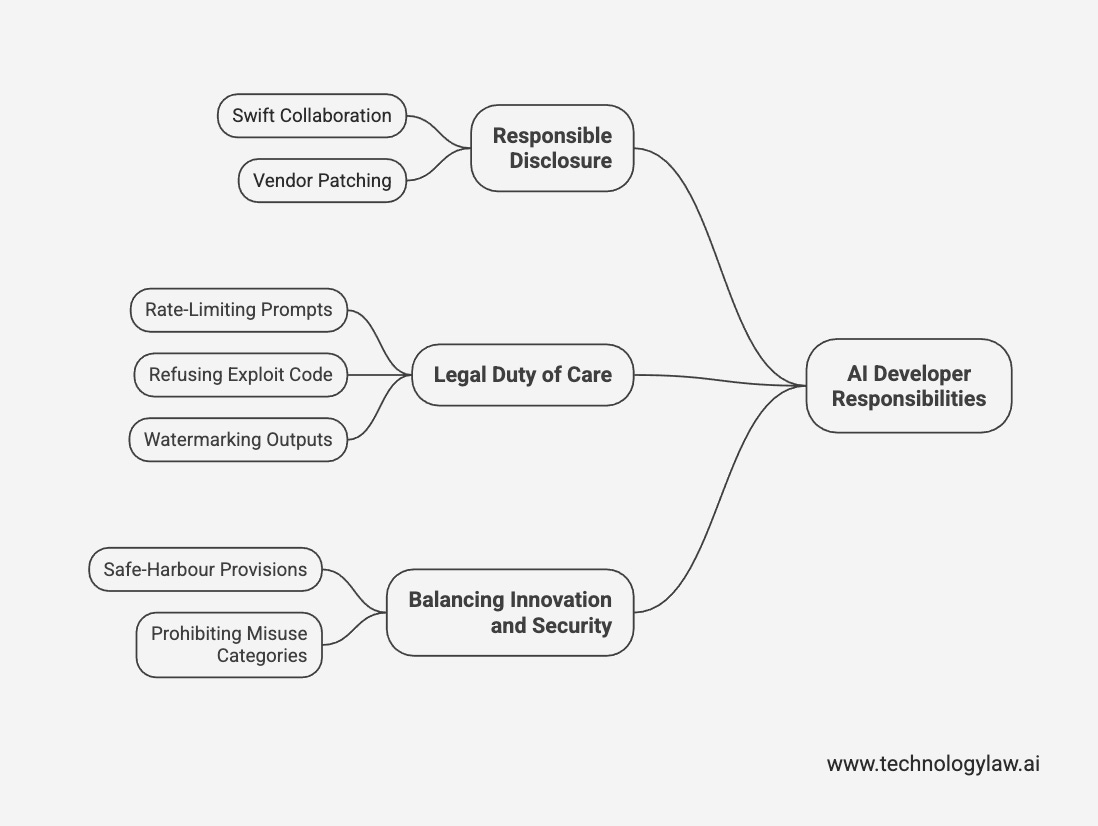
Google’s swift collaboration with the vendor to patch the vulnerability reflects responsible disclosure practices. However, not all AI‑enabled attackers will alert vendors.
Legislators may consider imposing a legal duty of care on AI developers to monitor for harmful outputs and restrict high‑risk functionalities. This could mean rate‑limiting vulnerability‑discovery prompts, refusing to generate exploit code, or watermarking outputs for traceability.
Of course, over‑regulation could stifle legitimate cybersecurity research and hinder the development of defensive AI tools. Lawmakers, therefore, face the delicate task of balancing innovation with security.
One suggestion is to adopt safe‑harbour provisions for researchers who use AI for defensive purposes and to prohibit only certain misuse categories, such as automated exploitation or large‑scale enumeration.
Under US federal law, the CFAA remains the primary statute for prosecuting hacking, but there is growing recognition that it is ill‑equipped for AI‑driven exploits.
Legislative proposals in Congress include modernising the CFAA to explicitly cover AI‑generated malicious code and clarifying that intent can be inferred when a user knowingly deploys AI outputs to breach security.
Separately, the Digital Millennium Copyright Act of 1998 (DMCA) prohibits circumventing technological protection measures, which could apply to AI scripts that bypass two‑factor authentication. The DMCA’s safe‑harbour for research might shield some AI‑driven vulnerability testing.
Internationally, the Budapest Convention on Cybercrime sets common standards but predates generative AI; its ongoing Protocol 2 negotiation may need to incorporate AI‑specific obligations.
Future directions
Given the novelty of AI‑assisted exploits, legal frameworks are still catching up. Ongoing discussions around AI liability, cyberwarfare norms, and responsible AI will likely incorporate lessons from this incident.

Expect regulators to require AI developers to implement usage monitoring, impose mandatory reporting of harmful outputs, and share threat intelligence with government agencies.
Meanwhile, courts will confront cases testing whether a person can be held liable for crimes committed using AI. These questions will shape the next decade of cybersecurity law.
Technology Law Tracker
1. AI addiction – first clinical case treated
In early May, addiction specialists in Venice treated a 20‑year‑old woman who developed a behavioural dependency on an AI chatbot. Local media reported that she was so immersed in conversations with the algorithm that she spoke almost exclusively to the bot and withdrew from real‑world interactions.
The addiction service of the Ulss 3 health authority took her into care, marking the first such case in Italy.
According to Dr Laura Suardi, head of Serd, the AI’s adaptive design, learning the user’s preferences and giving increasingly personalised responses, reinforced a pseudo‑friendship that was “the tip of the iceberg” of a wider problem.
She explained that limiting usage alone is ineffective; treatment requires psychological and psychiatric support and involves the patient’s family.
AI systems can indeed cause psychological harm, raising questions about their regulation under medical and consumer protection laws. Medical definition of addiction: Behavioural addictions, such as internet gaming or gambling disorder, are recognised in the Diagnostic and Statistical Manual of Mental Disorders (DSM‑5).
They involve compulsive engagement despite negative consequences. While “AI addiction” is not yet a formal diagnosis, the Venice case suggests that interacting with a conversational AI can satisfy criteria for behavioural addiction: impaired control, craving, and continuation despite harm.
Clinicians must therefore determine whether existing diagnostic categories suffice or whether a new classification is needed.
Healthcare providers owe patients a duty to diagnose and treat mental disorders. When an AI system causes harm, questions arise about whether the system's provider could be liable.
Under the EU Product Liability Directive, producers are strictly liable for defects that cause physical injury. Psychological harm is less clearly covered, but consumer protection laws could apply if the AI marketed itself as a well‑being tool and failed to warn users of addictive risks.
Italy’s consumer code prohibits unfair commercial practices and could be used to hold developers accountable for designing interfaces that are addictive.
2. arXiv’s one‑year ban for AI‑generated hallucinations in publications
Researchers and students widely rely on arXiv to circulate preprints.
On 15 May 2026, Thomas Dietterich, chair of arXiv’s computer science section, announced a new enforcement policy: if a submission contains clear evidence that the authors did not check language‑model output, such as hallucinated references or leftover prompts, the entire author team faces a one‑year ban, after which any subsequent submission must first be accepted by a peer‑reviewed journal.

Dietterich explained that arXiv’s code of conduct already states that authors are fully responsible for their content regardless of how it was generated; the new penalty gives that principle teeth.
Examples of “incontrovertible evidence” include:
Fake citations, meta‑comments such as “here is a 200‑word summary, would you like me to make any changes?” and
Tables containing placeholder data with instructions to the author.
Any such slip makes the entire paper untrustworthy, hence the one‑strike rule.
ArXiv’s policy responds to an explosion of AI‑generated content in scientific publishing. According to a recent study, fabricated citations have risen 12-fold since 2023; in early 2026, one in 277 papers contained at least one fake reference.
The surge correlates with widespread use of language models. Such errors propagate through citations and risk infecting downstream research.
ArXiv’s volunteer moderation system is not equipped to detect AI‑generated slop at scale, so the ban targets the most egregious cases.
Researchers may worry that using AI tools could expose them to penalties. Importantly, the policy does not ban AI outright. It acknowledges that authors may use AI for drafting or editing, provided they verify the output.

The key issue is scientific integrity. Authors must represent that they have reviewed and stand behind their work.
This resonates with AI misuse in legal practice, where US and UK judges have sanctioned lawyers for citing hallucinated cases.
In legal scholarship, mis‑citations could mislead courts and policymakers.
The arXiv penalty could therefore serve as a model for law journals and courts: a clear sanction deters irresponsible AI use without stifling legitimate assistance.
3. OpenAI offers ChatGPT Plus to Malta residents for free
On 17 May 2026, Malta announced a groundbreaking partnership with OpenAI. Every citizen and resident will receive a year of ChatGPT Plus free of charge after completing an AI literacy course.
The programme, dubbed AI for All, is delivered by the University of Malta and aims to teach participants what AI is, what it can and cannot do and how to use it responsibly.
Once they finish the online course, participants receive twelve months of ChatGPT Plus at no cost, including Maltese citizens living abroad.
The Malta Digital Innovation Authority manages access, and the scheme scales as more people complete the course. Government officials said the initiative is designed to transform an unfamiliar technology into practical assistance for families, students and workers.
The partnership comes amid litigation. In March 2026, Elon Musk sued OpenAI and Sam Altman, alleging breach of the company’s founding mission. It can be speculated that offering free subscriptions helps build goodwill.
We covered the ongoing OpenAI case of Elon Musk v. Sam Altman in our previous weekly briefing lead story.
Regardless of motivations, Malta’s programme could become a template for other countries.
If successful, it may inform how countries integrate AI into education and public services.
Conversely, if data breaches or misuse occur, it could prompt calls for stronger AI governance. For now, the scheme emphasises education and responsible adoption.
Case of the Week
Parties: Meta Platforms Ireland (Fair compensation)
Court: Judgment of the Court in Case C-797/23 (CJEU)
Facts and dispute
The dispute arose from Italian legislation implementing the EU Copyright in the Digital Single Market Directive (Directive 2019/790).
The law created a system requiring online service providers to pay publishers fair remuneration for using press publications on the internet.
Under this system, service providers must negotiate payments with publishers, provide relevant usage and revenue data, and refrain from reducing content visibility during negotiations. The Italian Communications Regulatory Authority (AGCOM) can set remuneration criteria, resolve disputes, and impose penalties.
Meta Platforms Ireland (Facebook’s European subsidiary) challenged AGCOM’s implementation of the law before an Italian administrative court. Meta argued that the Italian rules exceeded what EU law allows, infringing its freedom to conduct a business and misapplying the directive.
The Italian court referred questions to the Court of Justice of the European Union (CJEU) under the preliminary ruling procedure, asking whether the Italian system is compatible with EU law.
Legal issue and question
The core issue before the court was whether EU member states may impose a compulsory remuneration scheme on platforms for the online use of press publications and require negotiations without restricting content visibility.
Does such a system go beyond the rights and obligations established by the directive?
Meta argued that requiring payment irrespective of consent conflicts with Article 15 of Directive 2019/790, which grants publishers a related right to authorise or prohibit online use. It also claimed that mandatory negotiation and data‑sharing obligations unjustifiably restrict business freedom.
Decision
On 12 May 2026, the CJEU ruled that member states may enact systems that entitle publishers to fair remuneration for the use of their publications online, provided the payment is linked to authorisation.
Publishers must have the option to refuse authorisation or grant it free of charge, and no payment may be required when a platform does not use the publication.
The Court held that obligations to negotiate, to supply usage data and to avoid reducing visibility are permissible because they support a fair marketplace for copyright and help publishers recoup their investments.
While these obligations restrict the freedom to conduct a business, the Court found the limits justified and proportionate to the objectives of intellectual property protection and media pluralism.
Wider implications
The ruling affirms that EU law allows member states to strengthen publishers’ rights beyond the minimum floor set by the directive, as long as those measures respect the core rights — namely the ability to authorise use.
It clarifies that platforms cannot be required to pay when they do not host or index press content, and that publishers may choose to license content for free.
The decision supports the CJEU’s willingness to balance property rights with business freedoms. AGCOM’s authority to set remuneration criteria, decide disputes and impose penalties is validated.
Platforms operating in Italy and other EU countries may need to negotiate with publishers and share usage data. The case is particularly relevant for news aggregators, search engines and social networks.
What about platforms like Substack?
The ruling does not automatically apply to platforms hosting user‑generated newsletters. If a platform like Substack merely hosts content uploaded by publishers themselves, it is usually authorised.
The fair compensation requirement matters only when a platform uses third‑party press publications without permission, such as by displaying previews, recommendations or summaries that reproduce substantial extracts.
In such cases, Substack may need to negotiate payments under national transpositions of the directive. For ordinary linking or short excerpts, fair use exceptions may apply.
Writers posting their own newsletters remain unaffected; they are for the publisher and the authorising party.
Other Developments in Technology Law
1. The European Union ratifies the Council of Europe Framework Convention on Artificial Intelligence
On 15 May 2026, during the 135th Session of the Council of Europe’s Committee of Ministers in Chișinău, the European Union ratified the Framework Convention on Artificial Intelligence and Human Rights, Democracy and the Rule of Law.
The convention, adopted in 2024, is the first legally binding international treaty on AI.
It provides a legal framework covering the entire lifecycle of AI systems and aims to ensure that AI use is consistent with human rights, democracy and the rule of law. It promotes responsible innovation, is technology‑neutral and is open to non‑European countries.
As of now, signatories include the EU, the UK, the United States and several other non‑member states.
The convention will enter into force once five signatories, including three Council of Europe members, ratify it.
2. Automated Vehicles Act 2024 (Commencement No. 2) Regulations 2026
The UK government is gradually bringing the Automated Vehicles Act 2024 into force. The Commencement No. 2 Regulations 2026, signed on 20 April 2026, bring Part 5 of the Act (permits for automated passenger services) into effect on 15 May 2026.
Part 5 creates a permit scheme for services using automated vehicles, such as taxis, private hire cars, shuttles, and buses.
Operators must obtain permits before running such services, and future regulations will detail safety requirements, passenger protections and information sharing. Sections 84 and 89, which relate to civil sanctions, have not yet commenced.
Will this permit regime apply to Full Self‑Driving services, such as Tesla’s proposed robotaxi fleet? Not immediately. A vehicle must first be recognised as an authorised automated system under UK law.
Operators would then need a permit under Part 5, satisfy safety and passenger‑protection rules and ensure that the infrastructure communicates with the vehicle.
Because the regulations are tailored to passenger services operating on defined routes and under specific conditions, widespread robotaxi services will require additional approvals. The current commencement is therefore a step toward regulatory readiness, but not a green light for full self‑driving deployment.
3. HMRC to use AI for tax fraud detection
On 14 May 2026, the UK’s HM Revenue and Customs (HMRC) awarded a £175 million, ten‑year contract to London‑based AI company Quantexa to overhaul its data infrastructure and detect tax fraud.
The contract marks a deliberate move away from reliance on American surveillance company Palantir and demonstrates the government’s desire for sovereign AI.
Quantexa’s platform will unify HMRC datasets, use graph analytics to identify patterns of tax fraud and evasion, and support customer service operations.
Quantexa founder Vishal Marria stressed that automated decisions would still require human oversight and that HMRC data would remain inside the tax authority’s environment.

Linking fragmented tax datasets could help HMRC spot hidden networks of companies and individuals, close the £46.8 billion tax gap and improve response times to taxpayers.
However, using AI in tax enforcement raises questions under the GDPR.
Automated processing of financial data constitutes profiling, and Article 22 grants individuals the right not to be subject to decisions based solely on automated processing.
HMRC asserts that humans will verify AI‑flagged cases, which may fall under the GDPR’s legitimate interests exception (Recital 47), which allows data processing for fraud prevention.
However, there remain concerns about false positives and algorithmic transparency. Misclassification could lead to withheld refunds or penalties, placing burdens on taxpayers to contest AI‑generated suspicions.
Public law principles of fairness require HMRC to provide reasons for decisions and allow appeals. The Information Commissioner’s Office may scrutinise the deployment to ensure compliance.
The contract is part of the UK’s Sovereign AI initiative, funded with £500 million to support domestic AI champions. It follows criticism that government data contracts with Palantir have exported control of sensitive information.
Quantexa, a British company with early roots in anti‑money‑laundering, demonstrates that the UK aims to build its own AI infrastructure.
If successful, the deal may set a precedent for other departments, from healthcare to border control, to adopt domestic AI solutions. If the project fails or produces high false‑positive rates, sceptics will argue that only established giants can handle public‑sector data problems.
Latest Opportunities
Remote jobs in technology law
1. TKYC Analyst (Remote Canada/US), Avantia: An AI-first legal and compliance services provider. As a Transaction KYC Analyst, you will work alongside asset managers’ legal, compliance, and investment teams to help bring complex private equity deals to completion (find out more).
2. Regulatory Counsel (Remote Türkiye), Binance: A leading global blockchain ecosystem behind the world’s largest cryptocurrency exchange by trading volume and registered users. Assist with legal and regulatory matters related to financial products and services in the FinTech, crypto, and blockchain sectors (find out more).
3. Product Manager (Remote Japan), BoostDraft: BoostDraft is a software engineering company that develops IDEs for documents. Currently seeking Lawyers who draft relatively standardised but long documents, such as contracts (find out more).
4. Counsel, Applied Legal Research (Remote Singapore), Centari: Centari is hiring a transactional lawyer for its Applied Legal Research team to help develop AI tools for corporate legal work, combining expertise in corporate transactions, legal analysis and generative AI product development (find out more).
5. Legal Expert (Remote UK), YO IT: A remote‑based legal expert role advertised by a UK consultancy seeks professionals with expertise in technology law and digital regulation (find out more).
Conferences, fellowships, events and calls for papers.
6. Call for papers on Quantum Technology and Law, Leiden Law School: Leiden Law School invites chapters for an edited volume on quantum technology and law. Topics include legal, ethical, social, and regulatory issues linked to quantum technology. Abstracts should be 150 to 250 words, and chapters should be around 8,000 to 10,000 words. (find out more).
7. Free Microsoft Virtual Training Day: Protect Sensitive Information in the AI Era with Microsoft Purview (4 and 5 June 2026): Explore how Microsoft Purview identifies and labels sensitive data, enforces DLP policies across endpoints and cloud apps, and helps detect insider risks with Adaptive Protection. The session also covers Purview DSPM for deeper visibility into data exposure and AI interactions. Complete the training to receive 50% off the Information Security Administrator Associate exam. (find out more).
8. AI, Justice and the Rule of Law (Free Course): UNESCO and the University of Oxford are offering a free self‑paced online course launched on 27 April 2026 to equip judges, lawyers and students with an understanding of how AI interacts with human rights and legal reasoning (find out more).
Final Summary
AI regulation is quickly moving from abstract principles to concrete legal obligations. Google’s revelation of an AI‑generated zero‑day exploit shows that malicious actors are already weaponising generative AI models.
The AI addiction case reminds us that AI systems can harm psychological health, forcing lawmakers to consider mental‑health impacts when regulating digital services.
ArXiv’s one‑year ban for hallucinated references demonstrates that professional communities are willing to impose severe penalties to maintain trust.
Government initiatives, whether Malta’s national ChatGPT rollout or HMRC’s sovereign AI contract, illustrate that public‑sector adoption is accelerating despite unresolved questions about privacy, liability and fairness.
The coming years will require careful balancing of innovation with the protection of rights. Now is the time for informed, inclusive debate and for building institutions capable of governing AI responsibly.
Leave your comments to join the conversation.