

Professional negligence assesses the quality of service within a retainer. A lawyer's technological preference matters through its effect on that service. AI nevertheless changes the feasible means of performing legal work. This article argues that sustained refusal to assess a demonstrably useful, accessible and governable system may eventually supply evidence of breach where a lawyer thereby omits a material inquiry or imposes avoidable cost. Comparative doctrines in the United States, England and Wales, and Canada already accommodates that conclusion without treating AI adoption in legal practice as an independent obligation. Liability for refusal should require proof of an identified alternative workflow, its reliable availability at the relevant time, a material difference to the client, and ordinary principles of causation and loss.
Newsletter Edition 102

The standard of professional care
The relevant object of negligence law is the quality of the service a reasonably competent lawyer would have provided in the circumstances of a particular retainer. What changes as tools improve is the range of methods through which that service can reasonably be delivered.1
The U.S. law of professional competence already requires research proportionate to the problem. In Smith v Lewis, the California Supreme Court held that counsel should discover rules readily ascertainable by standard research and undertake reasonable research even where the law is unsettled.2 The reference to “standard” techniques identifies an historically contingent means of inquiry.
A search method that reliably exposes a decisive authority can become pertinent to competence as its usefulness becomes known. The older admiralty decision, The T.J. Hooper, establishes the narrower proposition that widespread failure to adopt a useful technology need not conclusively establish reasonable care; a court must still examine its practical utility, cost and the foreseeable loss.3 Neither judgment authorises a categorical requirement to consult a large language model.
English negligence law reaches a similar position through its insistence that professional practice remain defensible. In Edward Wong Finance Co Ltd v Johnson Stokes & Master,4 the Privy Council found a customary conveyancing practice negligent because its avoidable exposure to fraud made the custom unreasonable. Bolitho v City and Hackney Health Authority subsequently invoked the decision to explain why a body of professional opinion cannot insulate an indefensible practice.5 The analogy permits scrutiny of an established refusal to investigate new methods. It also permits a lawyer to justify abstention by reference to confidentiality, reliability or the cost of checking output.
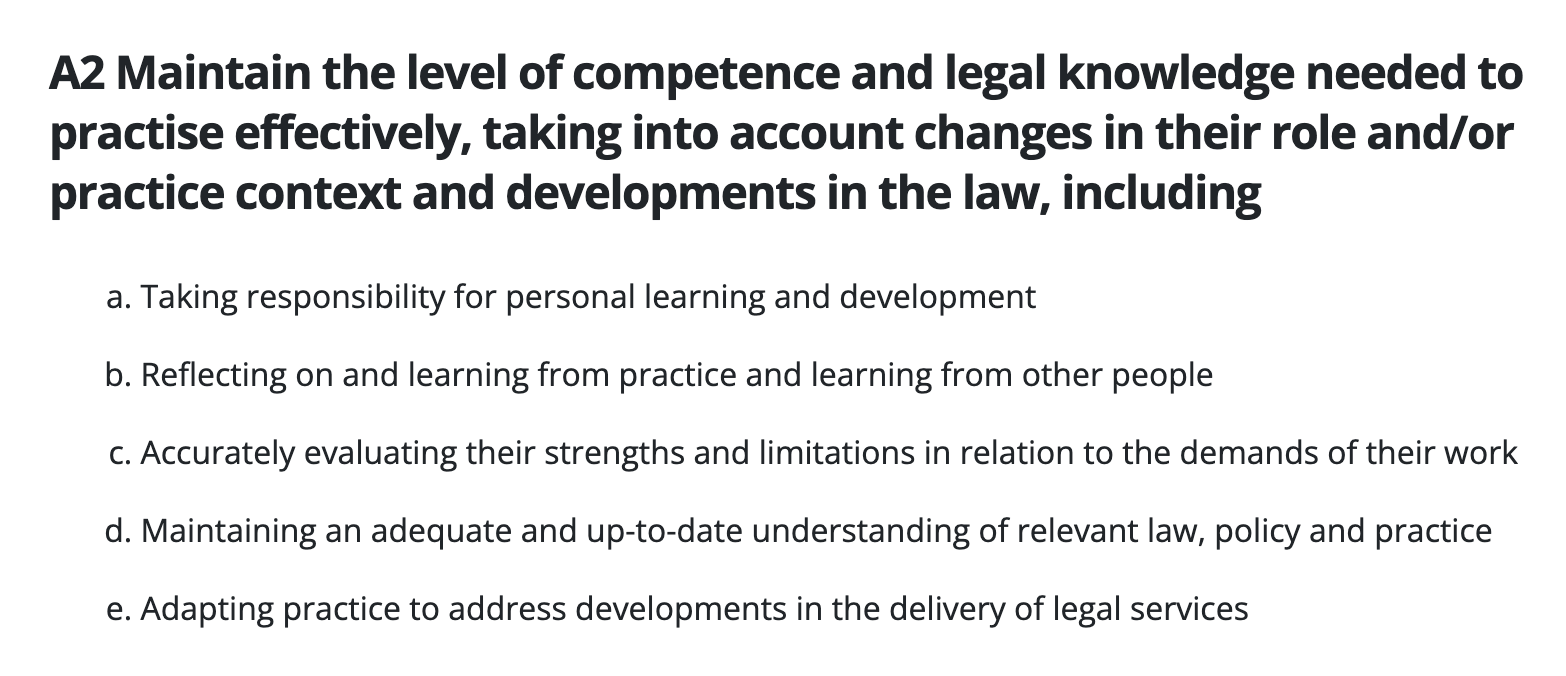
The SRA’s competence statement requires adaptation to developments in legal service delivery, while its Code requires competent, timely service and effective supervision. These regulatory obligations inform the factual context; they do not themselves decide a civil negligence claim.6
Canada is similar. In Central Trust Co v Rafuse, the Supreme Court required the solicitor to recognise legal issues within the work undertaken and ascertain the governing law where necessary. The Federation’s Model Code commentary calls for an understanding of, and ability to use, technology relevant to one’s practice.7 Relevance is conditional on the work.

The Model Code is a template for provincial regulation, and disciplinary competence remains distinct from the civil standard of care. In each jurisdiction, the information available when action was due and the foreseeable consequences of error delimit the inquiry.
Evidence of AI usefulness and its limits
Empirical evidence provides reason to question a general refusal to use AI. In a randomised study involving 206 law students, AI-generated highlighting reduced the time required to analyse legal complaints by 30 per cent without lowering the measured quality of the work. AI-generated summaries, however, produced no comparable improvement.8
A separate experiment found that GPT-4 increased speed across legal tasks, with only small and inconsistent improvements in quality. A later randomised study of advanced students found productivity gains of 50 to 130 per cent in five of six tasks using a legal retrieval system or a reasoning model.9
These are genuine experimental results, yet their subjects were students, their tasks selected, and the tested systems version specific. A productivity result cannot establish that a particular client would have received better advice.
Reliability evidence limits the inference further. A preregistered evaluation of commercial legal research systems found false or misleading statements in approximately 17 to 33 per cent of responses to its selected queries. Its authors expressly disclaimed any estimate of the population wide rate of error in ordinary legal practice.10
Earlier tests of general models on specific federal case questions yielded hallucinations in 58 to 88 per cent of responses under their test conditions. The studies measured different systems and queries; their percentages cannot be aggregated into a single risk score. They show that source linked output still requires checking against the underlying authority.11 A plausible answer may be more dangerous when its fluency discourages further inquiry.
Legal work presents a further difficulty of measurement. An extracted clause may be accurately located while its legal significance depends on a negotiated allocation of risk; a case summary may quote a genuine judgment yet suppress a jurisdictional qualification. Hildebrandt’s account of statistical prediction and legal meaning, and Remus and Levy’s task based analysis of legal practice, explain why speed in a separable operation does not establish the quality of the resulting professional judgment.
Research on human oversight similarly cautions against assuming that a lawyer reviewing automated output will reliably detect errors: interface design and the distribution of attention matter. The appropriate comparison is therefore between complete workflows, including source inspection, revision and supervision, under conditions resembling the retainer.
Comparative professional regulation
The American Bar Association Model Rule 1.1, comment 8, requires lawyers to remain abreast of the benefits and risks of relevant technology. Formal Opinion 512 addresses the competence, confidentiality, communication, supervision and fee issues arising when generative AI is used.12 It requires a reasonable understanding of a chosen system’s capacities and limitations and independent review appropriate to the work.

The opinion does not require its use in every representation; the ABA’s model instruments are not, without state adoption, binding local law.13 A lawyer unable to distinguish retrieval from generated assertion may already fail the duty to keep informed, even if abstention from deployment is justified.
In England and Wales, the SRA’s August 2026 warning notice concentrates on fabricated material and confidentiality. It reiterates that firms remain accountable for AI assisted work and must provide competent service.14 Ayinde v Haringey concerned false authorities placed before the court and failures of verification; the judgment concerned duties to the court and disciplinary referral, rather than a client’s claim for damages caused by refusal to use technology.15

In the United States, Mata v Avianca likewise imposed sanctions after lawyers relied on fictitious cases.16 In British Columbia, Zhang v Chen addressed hallucinated authorities and the costs incurred in identifying them.17 These decisions establish a judicial response to misuse. Their practical significance for abstention is indirect: adopting a system without effective checking can produce a worse standard of care than a careful manual process.
Canadian and English guidance recognises the same constraint in relation to confidential material. The Ontario law society’s white paper and the SRA warning notice require attention to data use and safeguards; the latter raises a specific concern about entering client material into an open public tool.
Any comparison between AI assisted and conventional work must price the cost of lawful deployment. A firm’s secure contractual environment may make a workflow reasonable for its lawyers when the same workflow would be indefensible for a sole practitioner using a public service. Professional competence should not be inferred from the procurement budget of the largest firms.
When refusal to use AI may potentially amount to breach
The relevant distinction lies between inquiry into a tool and its deployment. A lawyer who rejects every AI system without examining any task relevant evidence risks failing to understand available methods. A lawyer who has evaluated an AI can properly decline it where verified alternatives meet the client’s needs.
A negligence claim based on refusal would be strongest where a stable, accessible system had been validated for a narrow task; it could be used without exposing protected data; its output could be audited within the time available; and failing to use it foreseeably caused a material omission or unnecessary expense. Those conditions elaborate the application of existing doctrine.18
Consider an urgent disclosure exercise involving a very large collection of documents. A tested ranking or classification system may permit review within the deadline when a manual process cannot. A lawyer who refuses even to assess that option, misses responsive material and cannot explain an equivalent method presents a plausible breach case. Its force depends on contemporaneous evidence of the system’s accuracy on this collection, recall requirements, validation cost and the lawyers’ ability to examine contested documents.
The literature on augmented lawyering identifies the organisational capacities on which effective use depends; studies of legal aid show why benefits and available infrastructure differ across practice settings.19 A generic claim that AI works faster could establish none of those facts.
The case changes when the proposed tool generates/hallucinates legal authorities. One would need to establish that its assistance, followed by independent review, was more likely than conventional research to identify the omitted authority within the available time.
The proponent must specify the database coverage and version available on the day, rather than reconstruct a superior search after litigation begins. Even widespread professional adoption is equivocal evidence where outputs are difficult to verify. The principles illustrated by The T.J. Hooper and Edward Wong allow courts to scrutinise collective habit without converting vendor claims into a legal standard.
The billing structure complicates the assessment. Under a time based fee, reduced labour may lower the client’s bill; it may also reduce a firm’s revenue. Formal Opinion 512 prevents lawyers from charging for time they did not spend and requires reasonable treatment of technology costs.
Financial incentives deserve scrutiny when a lawyer declines a demonstrably efficient method, although a fee dispute alone establishes neither breach nor compensable loss. Clients may legitimately prefer a different method after receiving meaningful information about cost, confidentiality and expected quality. Their instructions define the retainer subject to counsel’s independent duties to the court and professional regulator.
Proof, institutional responsibility and conclusion
Civil liability still requires causation. A claimant alleging an omitted authority must show its likely effect on the advice or proceeding; a claimant alleging excessive fees must identify expenditure reasonably avoidable by a feasible alternative. Perry v Raleys Solicitors demonstrates the need to prove what the client would have done on proper advice before valuing a lost opportunity dependent on others’ conduct.20
The changing performance of AI models intensifies the evidential problem. A present demonstration of an improved product is weak evidence of what a lawyer could have obtained at an earlier date. Records of procurement decisions, test sets, security assessments and review procedures can assist the contemporaneous inquiry, provided that documentation does not become a ritual detached from actuality.
Organisational responsibility also deserves separate attention. Law firms choose subscriptions, access permissions, training and review protocols; an individual lawyer may lack power to alter those choices. Scholarship on law firm technology finds that productive adoption depends on complementary organisational arrangements, and work on human oversight shows why nominal human sign off is an inadequate control. Attribution of civil fault must track the actual retainer and control over the relevant decision. Regulatory supervision can address systemic failures before an injured client can prove a claim.
Refusal to use AI can therefore become professionally negligent in a specific and provable setting, especially where it satisfies a reliable method of locating material that competent work required.
Present doctrines does not support liability for a lawyer’s declared preference alone. The professional obligation with the clearest foundation is to maintain an informed, revisable account of available methods and to choose a defensible workflow.
As systems improve, the evidential burden of explaining abstention may grow in some practices. Whether that burden matures into damages liability will depend on demonstrated client loss.21
Harry Surden, ‘Artificial Intelligence and Law: An Overview’ (2019) 35 Georgia State University Law Review 1305; Ian Rodgers, John Armour and Mari Sako, ‘How Technology Is (or Is Not) Transforming Law Firms’ (2023) 19 Annual Review of Law and Social Science 299.
Smith v Lewis (1975) 13 Cal 3d 349, 358–59.
The T.J. Hooper 60 F 2d 737, 740 (2d Cir 1932).
[1984] AC 296; [1984] 2 WLR 1.
Bolitho v City and Hackney Health Authority [1998] AC 232 (HL) 241–43.
Solicitors Regulation Authority, Statement of Solicitor Competence (2022), A2(e); SRA Code of Conduct for Solicitors, RELs, RFLs and RSLs, paras 3.2, 3.5–3.6.
Central Trust Co v Rafuse [1986] 2 SCR 147; Federation of Law Societies of Canada, Model Code of Professional Conduct, r 3.1-2, commentary [4A].
Aileen Nielsen and others, ‘Building a Better Lawyer’ (2024) 21 Journal of Empirical Legal Studies 979.
Jonathan H Choi, Amy B Monahan and Daniel Schwarcz, ‘Lawyering in the Age of Artificial Intelligence’ (2024) 109 Minnesota Law Review 147; Daniel Schwarcz and others, ‘AI-Powered Lawyering’ (2026) Journal of Law and Empirical Analysis, doi:10.1177/2755323X261427048.
Varun Magesh and others, ‘Hallucination-Free? Assessing the Reliability of Leading AI Legal Research Tools’ (2025) 22 Journal of Empirical Legal Studies 216.
Matthew Dahl and others, ‘Large Legal Fictions: Profiling Legal Hallucinations in Large Language Models’ (2024) 16 Journal of Legal Analysis 64.
American Bar Association, Model Rules of Professional Conduct, r 1.1, comment 8; ABA Standing Committee on Ethics and Professional Responsibility, Formal Opinion 512, Generative Artificial Intelligence Tools (29 July 2024).
Mireille Hildebrandt, ‘Law as Computation in the Era of Artificial Legal Intelligence’ (2018) 68 University of Toronto Law Journal 12; Dana Remus and Frank Levy, ‘Can Robots Be Lawyers?’ (2017) 30 Georgetown Journal of Legal Ethics 501.
Solicitors Regulation Authority, ‘Misuse of AI: Warning Notice’ (17 August 2026).
[2025] EWHC 1383 (Admin); Rebecca Crootof, Margot E Kaminski and W Nicholson Price II, ‘Humans in the Loop’ (2023) 76 Vanderbilt Law Review 429.
Mata v. Avianca, Inc., 678 F. Supp. 3d 443 (S.D.N.Y. 2023).
Zhang v Chen, 2024 BCSC 285.
John Armour, Richard Parnham and Mari Sako, ‘Unlocking the Potential of AI for English Law’ (2021) 28 International Journal of the Legal Profession 65; Jennifer A Brobst, ‘The Lawyer’s Duty to Understand the Disparate Impact of Technology in the Legal Profession’ (2024) 20 University of St Thomas Law Journal 150.
Benjamin Alarie, Anthony Niblett and Albert H Yoon, ‘How Artificial Intelligence Will Affect the Practice of Law’ (2018) 68 University of Toronto Law Journal 106; John Armour, Richard Parnham and Mari Sako, ‘Augmented Lawyering’ (2022) University of Illinois Law Review 71.
Perry v Raleys Solicitors [2019] UKSC 5.
Frank Pasquale, New Laws of Robotics: Defending Human Expertise in the Age of AI (Harvard University Press 2020).
Lawyers have always chosen among different research methods, but that freedom has never been unlimited. If refusing an available technology like AI causes them to miss a key authority, waste a client’s money, or mishandle a demanding disclosure exercise, the refusal may become legally significant.