


English law has spent more than a decade pretending that digital value could be economically real yet legally peripheral, and the Property (Digital Assets etc) Act 2025 exposes how unsustainable that posture had become. Treating cryptoassets as something to be tolerated rather than classified produced uncertainty that benefitted speculation while undermining credit, enforcement, and accountability. Legislative recognition arrives late, not visionary, and it reflects institutional pressure rather than conceptual enthusiasm.

Newsletter Edition 85
Digital property is no longer a theoretical category reserved for academic debate or courtroom experiments at the edge of private law, and the Property (Digital Assets etc) Act 2025 confirms that reality with a clarity that many governments have avoided for years.
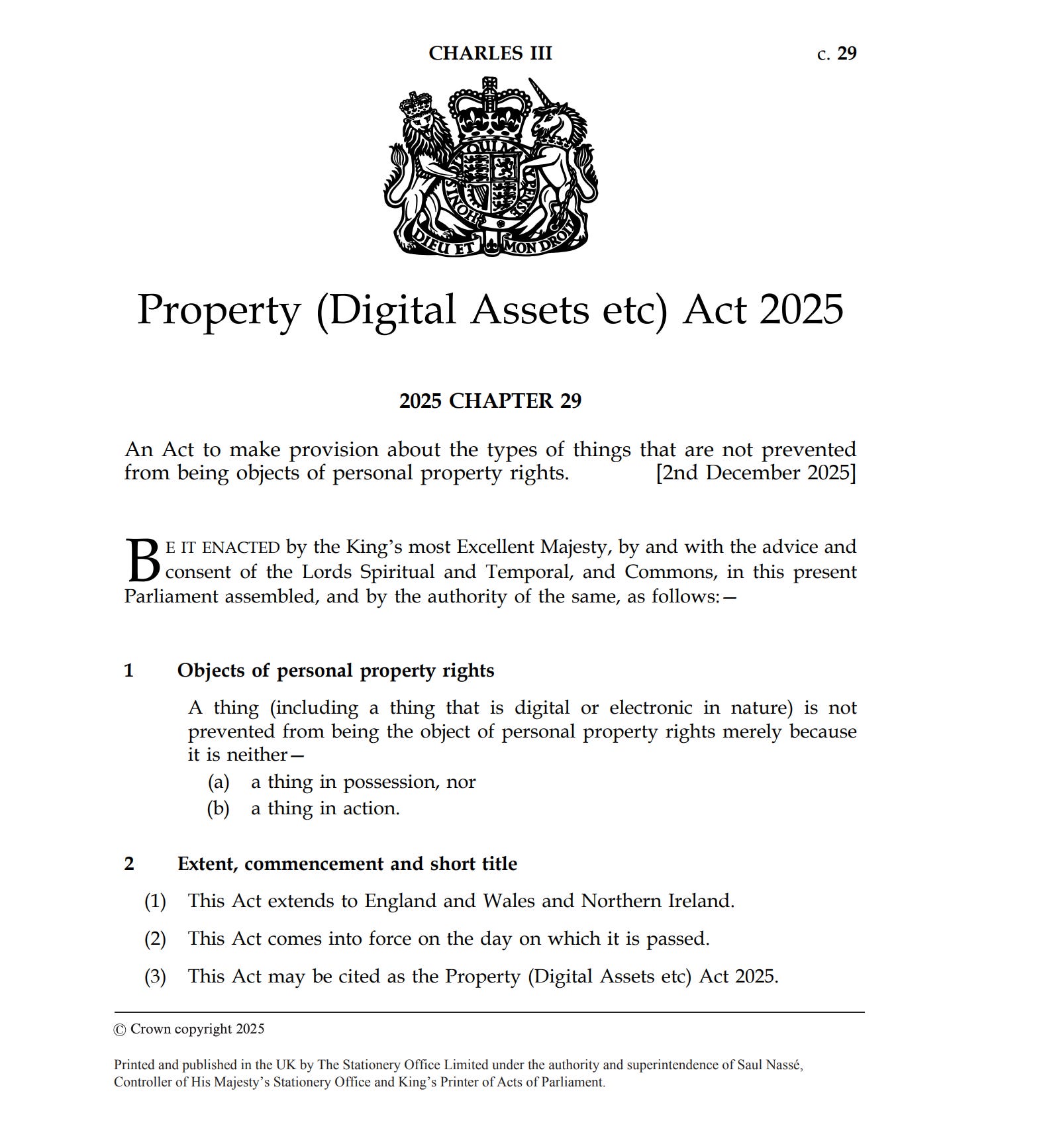
This legislation matters because it places digital assets within the paradigm of property law rather than treating them as contractual conveniences or technological curiosities, and that decision has consequences for credit, debt, and access to finance that extend well beyond England and Wales.
Readers who have followed cryptocurrency since its early years will recognise a long period where value existed without legal recognition as property, and that gap created friction in every interaction with the financial system, particularly where lending, security, insolvency, and enforcement were involved.
The Act addresses that gap directly, and it does so with implications that are global in scope.
What the Act actually does
The Property (Digital Assets etc) Act 2025 confirms that certain digital assets are capable of being objects of personal property even where they do not fit neatly within traditional categories such as choses in possession or choses in action.
That statement appears simple, yet it resolves a problem that has affected courts, lenders, insolvency practitioners, and investors for more than a decade.
English law has historically relied on categories that assume tangibility or enforceable rights against a person.
Cryptocurrencies and related digital assets sit awkwardly outside those assumptions. They exist, they hold value, they can be controlled, and they can be transferred, yet they do not depend on a counterparty in the conventional sense.
The Act acknowledges this reality and provides statutory confirmation that these assets are not legal outliers.
Several court decisions paved the way for this outcome.
AA v Persons Unknown [2019] EWHC 3556 (Comm) confirmed that cryptoassets could be treated as property for the purposes of granting proprietary injunctions.
Ion Science v Persons Unknown [2020] EWHC 3688 (Comm) reinforced the view that digital assets could attract proprietary remedies.
Tulip Trading v Bitcoin Association [2022] EWHC 667 (Ch) raised more difficult questions about control, duties, and decentralised governance, but it still accepted the premise that the assets themselves were capable of being property.
The Property (Digital Assets etc) Act 2025 consolidates this judicial direction and removes uncertainty that had persisted because those decisions rested on common law reasoning rather than legislative authority.
Why property status matters for credit and debt
Property status determines whether an asset can be used as collateral, whether it can be seized, whether it can be traced, and whether it survives insolvency. These questions are not academic. They decide whether lenders extend credit and whether borrowers gain access to capital on workable terms.
Cryptocurrency markets have grown in value without integration into mainstream credit systems because lenders rely on enforceability. A bank does not care about technical novelty. A bank cares about priority, certainty, and recovery. Without clear property status, digital assets sit outside the risk models that underpin lending decisions.
The Act brings digital assets closer to those models.
Collateralisation becomes legally intelligible once an asset is recognised as property. Enforcement becomes conceptually coherent once courts can treat digital assets as things rather than abstractions. Insolvency treatment becomes predictable once assets can be identified, valued, and distributed.
None of this requires enthusiasm for cryptocurrency as a social project. The law does not need belief. The law needs classification.
Access to finance and developing countries
Access to finance remains one of the most persistent structural problems facing developing economies. Credit is expensive, collateral is scarce, and legal infrastructure often struggles to support complex financial arrangements. Digital assets have often been presented as a partial response to these problems, yet legal uncertainty has limited their practical use.
Recognition of digital assets as property under a major commercial legal system has effects that travel beyond its borders.
English law remains a preferred governing law for international finance, commodity trade, and cross border lending. Legal recognition under English law influences contract drafting, risk allocation, and enforcement strategies in transactions involving parties across Africa, Asia, and Latin America.
Once digital assets can be recognised as property under English law, they can be referenced more comfortably in security agreements, trust arrangements, and financing structures that rely on English legal concepts. That matters in jurisdictions where domestic law may lag behind technological practice but where English law still governs the underlying transaction.
The Property (Digital Assets etc) Act 2025 does not solve access to finance, yet it removes one of the barriers that made digital assets unusable as serious financial tools in cross border contexts.
Debt, default, and enforcement
Debt markets depend on predictable outcomes in default scenarios. Creditors extend funds based on assumptions about recovery, ranking, and control. Digital assets challenged those assumptions because enforcement did not fit neatly into established procedures.
Recognition as property allows courts to issue proprietary remedies with greater confidence. Freezing orders, tracing claims, and equitable relief become easier to justify when the asset in question sits within a recognised legal category.
This matters for creditors, but it also matters for debtors. Legal clarity reduces the scope for arbitrary outcomes and inconsistent treatment. A system where enforcement is uncertain tends to favour those with superior resources and technical sophistication.
Clear classification improves procedural fairness even when outcomes remain contested.
Cryptocurrency and philosophical discomfort
Cryptocurrency has always produced philosophical discomfort within legal systems built around central authority. Property law developed in contexts where ownership could be anchored to physical control or legal rights against identifiable persons. Digital assets challenge both assumptions.
The Act represents an acceptance that law must describe reality rather than insist on historical categories. Control over a digital asset may be exercised through cryptographic keys rather than physical possession, yet control remains control. Exclusion remains possible. Transfer remains meaningful.
This does not resolve deeper debates about decentralisation, governance, or power. It simply recognises that value exists and that law must account for it.
Philosophically, this approach treats law as an organising system rather than a moral referee. The Act does not endorse cryptocurrency as good or bad. It acknowledges existence and assigns legal consequences.
Do you know that there are currently no international uniform conflict of law rules governing crypto assets globally? Read our newsletter to find out more:

Many readers associate property law with land registries and conveyancing documents rather than digital wallets. The relevance becomes clearer once everyday interactions are considered.
Loss through fraud becomes a legal issue once assets are recognised as property.
Inheritance planning becomes coherent once digital assets can be treated as part of an estate.
Business balance sheets become more accurate once digital assets can be recognised as assets rather than accounting anomalies.
Employment disputes, marital property disputes, and insolvency proceedings increasingly involve digital assets. Legal recognition improves consistency across these contexts.
International implications
The Property (Digital Assets etc) Act 2025 contributes to an emerging consensus among advanced legal systems that digital assets require bespoke treatment within property law. That consensus affects regulatory coordination and private ordering.
Many countries seeking to attract investment often look to English law as a reference point. Legislative recognition creates a benchmark that others may follow, adapt, or resist.
Developing countries face a particular tension. Digital assets offer potential tools for inclusion, yet legal uncertainty increases risk. External legal frameworks often fill that gap. Recognition under English law provides a reference that can be leveraged even where domestic reform remains slow.
This does not impose English law on others. It influences contractual choices and dispute resolution preferences that already exist.
Cases that still matter
Despite legislative clarity, courts will continue to play a central role. Property status answers foundational questions but leaves many issues open.
Control and responsibility within decentralised systems remain contested.
Duties of developers and network participants remain uncertain.
Custody arrangements raise questions about bailment, trust, and fiduciary responsibility.
Tulip Trading case illustrates that property recognition does not resolve governance disputes. It frames them. Litigation will continue to define boundaries, particularly where losses occur and responsibility is disputed.
Interested in reading more about restitution and tort of conversion over crypto assets? Check out this newsletter:
Key points from this new legislation
Digital assets are now explicitly capable of being property under English law.
Property status affects credit, collateral, restitution, trusts, insolvency, and enforcement.
Legal clarity improves predictability without endorsing any technology.
Cross border finance benefits from alignment with English legal concepts.
Courts remain central in resolving unresolved governance questions.
Closing reflections
The Property (Digital Assets etc) Act 2025 places cryptocurrency within the machinery of private law rather than treating it as an exception that must be managed at the margins. That choice carries weight because property law structures economic life in ways that regulation alone cannot.
Recognition does not eliminate risk, volatility, or misuse. It reduces ambiguity. Ambiguity tends to favour insiders and penalise those without access to specialised expertise. Legal clarity distributes understanding more evenly, even when outcomes remain contested.
Property law has always been about allocating risk, value, and responsibility. Digital assets now sit within that framework, and the conversation about their role in credit, debt, and access to finance becomes more grounded as a result.
Comments are welcome on how recognition of digital assets as property may influence finance, responsibility, and legal coherence.
Very interesting read! I am glad governments all over the world have stopped avoiding this topic.
Fab
https://open.substack.com/pub/organon/p/the-nightmare-before-christmas-the-2fd?r=5rmgdf&utm_campaign=post&utm_medium=web&showWelcomeOnShare=true