


Abstract
This article examines whether digital markets today reproduce imperial relations through the extraction of data and the external control of essential computational systems. It argues that “algorithmic dependency” is a useful legal and political-economy concept where a state or community supplies data, labour or markets but cannot meaningfully govern the systems that convert them into value. The analogy to colonialism is structural, not literal, in that digital platforms do not ordinarily exercise territorial sovereignty, and data cannot simply be treated as a natural resource owned by a state, not yet at least. However, concentrated control over cloud services, AI models, standards and distribution can constrain policy choices. Existing law offers partial tools, specifically privacy and transfer rules, competition law, procurement, intellectual property and trade disciplines—but no integrated framework for equitable value creation and control exists. Our article proposes a rights-based, development-centred agenda built around demonstrable switching rights, accountable public procurement, local capability and meaningful participation in international data governance.
An Introduction
The language of imperialism is increasingly used to describe the global digital economy.
Data imperialism lies in a visible asymmetry where people and institutions generate data and depend on digital services, while a small number of firms control many of the infrastructures through which data are stored, analysed and converted into commercial and political advantage.
For governments in low-income states, the problem is that public administration, commerce and social life may become dependent on privately governed systems whose infrastructure, pricing, rules of access and technical standards are set elsewhere.1
Our article asks when that dependence should be understood as a new imperial relation and what law can do about it. We use “algorithmic dependency” to describe a condition in which a polity’s practical ability to make and implement choices is materially constrained by its reliance on external data infrastructure, computational capacity, AI models or platforms.
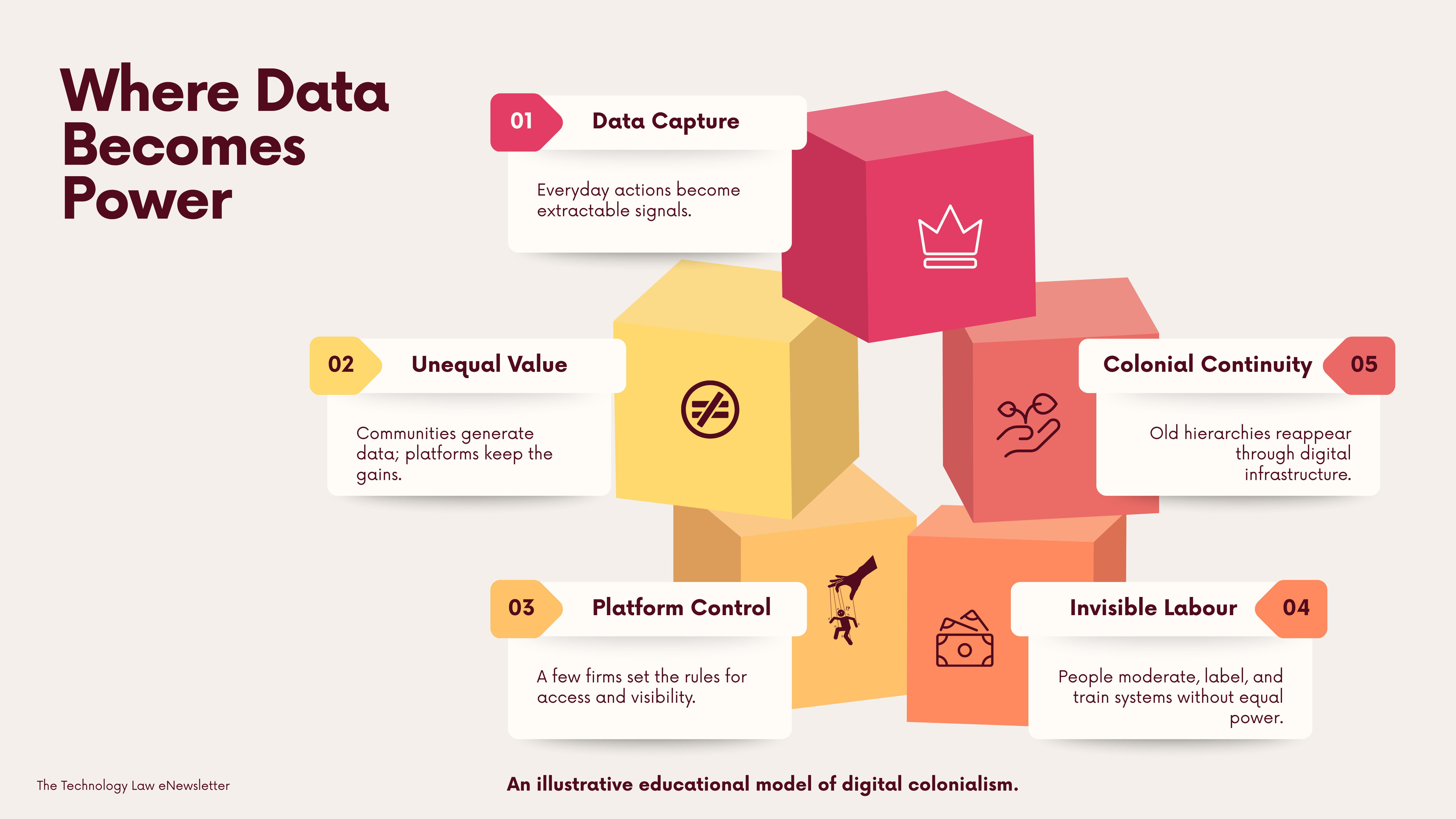
Dependency is not established by foreign ownership alone. It arises where exit is prohibitively costly, local alternatives and expertise are weak, data and learning effects accumulate outside the jurisdiction, or decisions affecting the community are embedded in systems it cannot effectively inspect or contest.2
Digital firms do not generally govern territory, levy taxes, or possess the coercive authority of colonial administrations. Digital services also deliver real benefits, including connectivity, lower transaction costs, scalable computing, and tools that local enterprises may not otherwise build.
Of course, to call every cross-border service colonial would obscure those differences and weaken the analysis. The more defensible claim is far narrower. Some digital relations reproduce recognisable structures of extraction and external control, even where their legal form is contract, platform access or cloud procurement rather than conquest in a traditional sense.
The argument in our article proceeds in four steps.
First, we identify the features that make digital dependence imperial in structure.
Secondly, we test the claim against existing legal doctrines, including human rights, data protection, sovereignty, competition and trade.
Thirdly, we explain why those regimes, taken separately, leave a value-and-capability gap.
Finally, we propose a practical legal agenda.
Our objective in this article is neither autarky nor data enclosure. We want to ensure that cross-border digital exchange remains compatible with (human) rights, public accountability and the capacity of communities to influence their technological futures.
From extraction to dependency
The concept of data colonialism offers a starting point. Couldry and Mejias describe data relations as a process through which human life is rendered available for continuous extraction and commercial use, analogous in certain respects to the appropriation of land and labour under historical colonialism.
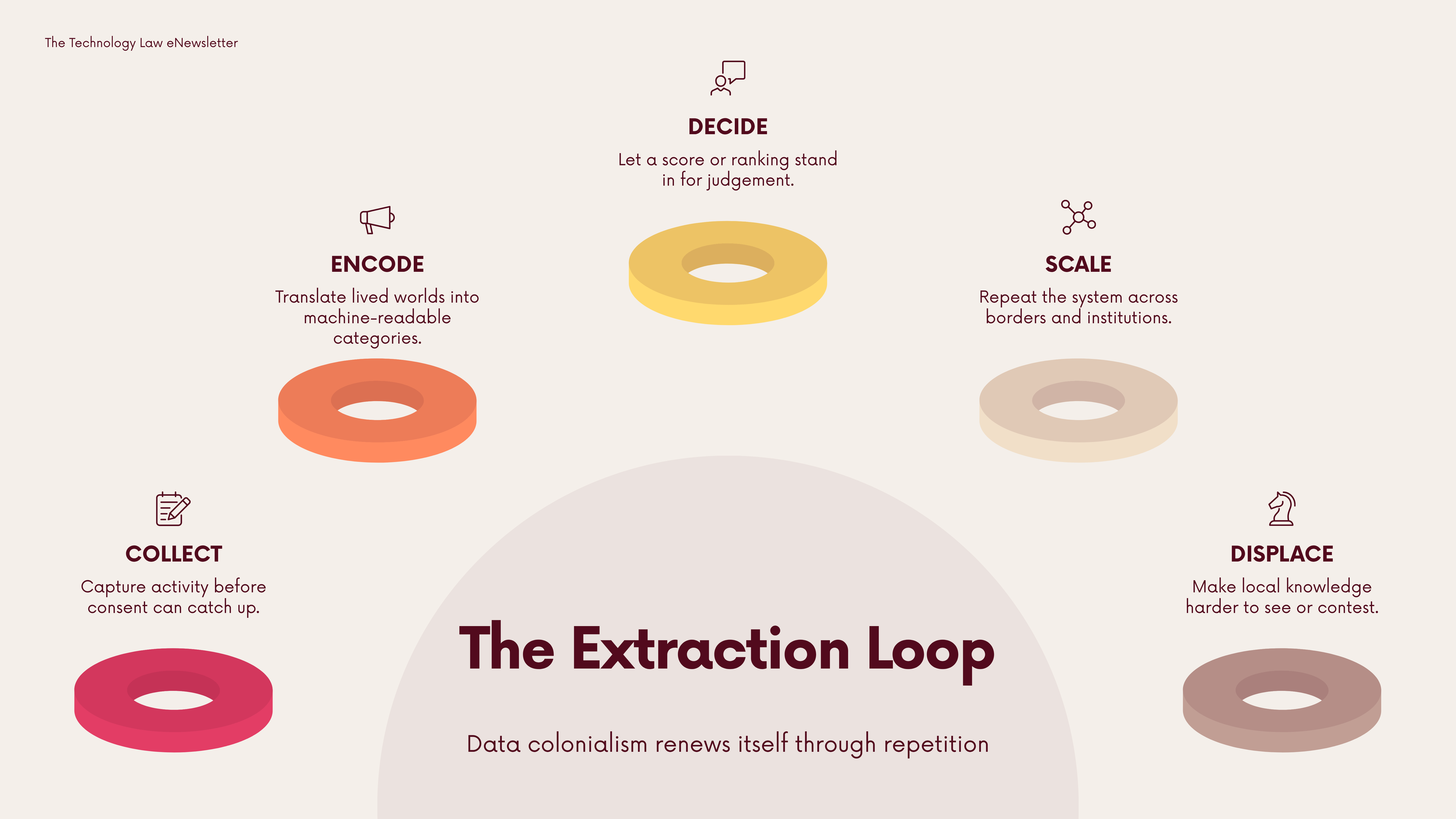
Their account is illuminating because it shifts attention away from isolated privacy violations toward the social order that normalises pervasive collection.
It is not, however, a legal conclusion. Whether a practice is exploitative depends on who controls the relevant systems, who bears risk, who receives value and what legal or political choices remain available.
At least three mechanisms are important here.
The first is asymmetric value capture. Users, workers, public bodies and businesses supply behavioural, transactional and administrative data, often as a condition of participating in ordinary life.
Firms combine those inputs with proprietary software, compute, capital and expertise to produce analytics, prediction and services. Value is jointly produced, but the terms on which it is captured are rarely negotiated by the data subjects or communities whose activity makes the system useful.3
The UK government has warned that some developing economies risk remaining suppliers of raw data while purchasing the digital intelligence generated from it. That diagnosis is not proof that all data should be locally owned; it is evidence that the distribution of productive capacity deserves legal scrutiny.
The second mechanism is infrastructural concentration. Cloud services reduce the cost of building and maintaining digital systems, and hyperscale providers can offer security, reliability and innovation that would be difficult for small domestic providers to match.4
The same economies of scale can produce concentration, dependence on proprietary tools and difficult migration. The World Bank and IFC have identified both the development potential of cloud markets and risks from vertical integration and increasing concentration. If public records, health systems or tax administration become deeply integrated with one provider’s proprietary services, the nominal ability to terminate a contract may not amount to a credible ability to exit.5
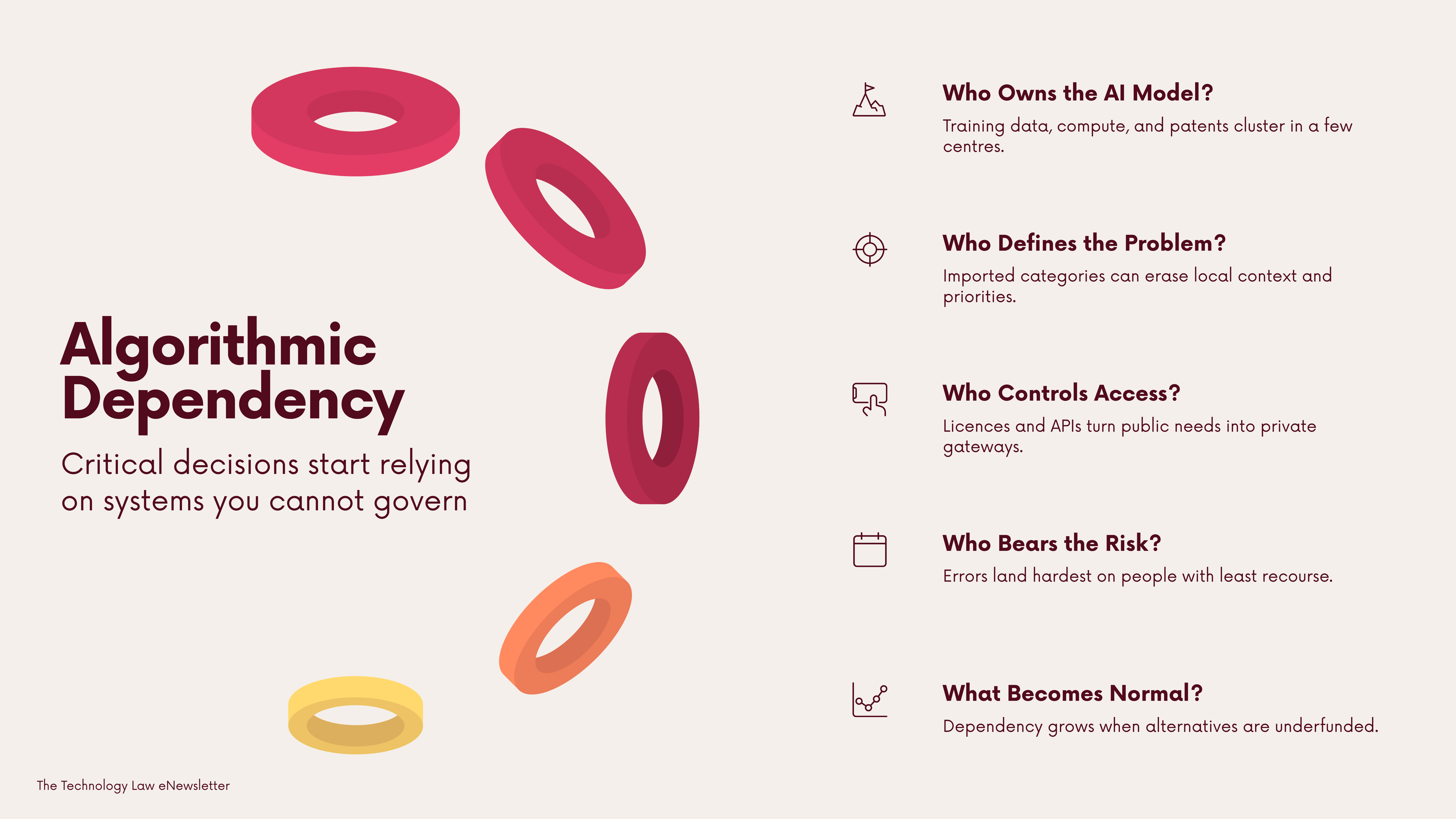
The third is epistemic and regulatory dependence. A state may host or purchase a system without having the engineers, audit access or bargaining power needed to understand how it works.
AI models can influence how people and cases are classified, which ones receive priority and where attention is directed. Platforms influence who can reach a market, while cloud providers help determine how public data is stored and shared.
However, when these systems are opaque, externally governed and difficult to replace, public authorities may retain formal jurisdiction while losing practical control. Algorithmic dependency thus concerns the allocation of decision-making capacity, not merely the location of servers.
These mechanisms will often interact. Data gathered at scale improve services and AI models; better AI models attract more users; user growth strengthens the platform’s position and produces still more data.
Network effects and switching costs can therefore convert an initial commercial choice into a durable institutional relationship. That pattern has a family resemblance to older extractive economies, in which peripheral regions supplied raw materials while processing, finance and rule-making were concentrated elsewhere.
The analogy is strongest where local actors contribute essential inputs but lack a fair share in the resulting capabilities and rents. It is weaker where services are genuinely substitutable, contracts are contestable, and domestic institutions retain effective oversight.6
What existing law can and cannot do
The law should not be based on an abstract claim that a state owns all data generated within its borders. Personal data protection gives individuals rights against collection and use; it does not generally assign ownership of data or guarantee a community share in the economic value created from it.7
The GDPR’s rules on international transfers condition data export on safeguards and enforceable rights.
In Schrems II, the Court of Justice required an assessment of whether protections in a recipient jurisdiction were essentially equivalent in light of public-authority access and effective remedies. The judgment demonstrates that data may cross borders without becoming legally ungoverned. It also shows the limits of transfer law: it addresses protection against rights violations, not the wider distribution of value, industrial capacity or platform power.8
International human rights law supplies a broader, but still indirect, foundation. Article 1 of both the International Covenant on Civil and Political Rights and the International Covenant on Economic, Social and Cultural Rights recognises peoples’ right to self-determination and their ability to dispose of natural wealth and resources.9
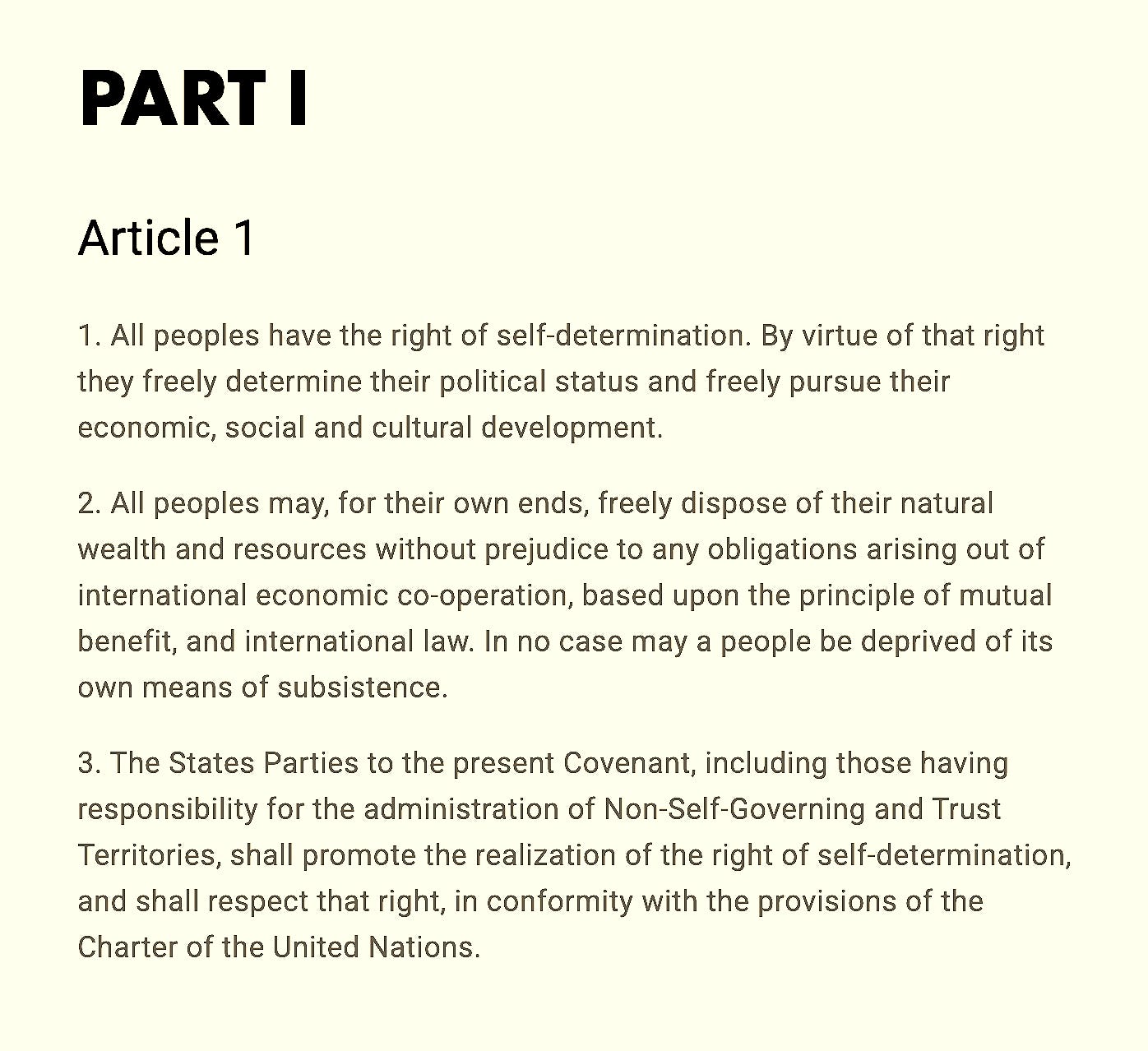
UN General Assembly Resolution 1803 similarly affirms permanent sovereignty over natural resources.

These instruments arose in the context of decolonisation and resource control, and they support the proposition that development choices should remain subject to peoples’ interests.
They do not establish that digital data are “natural resources” in a technical legal sense, nor that a state has title to every datum produced by its population.10
A simple transfer of resource-sovereignty doctrine to data would overlook privacy, plural ownership, collective interests and the non-rival character of information.
Data governance is also impacted by trade law. Digital trade rules can protect cross-border supply of services and constrain certain localisation requirements. Such mechanisms can support openness, but the distributional consequences depend on the precise commitments, exceptions and regulatory space retained by states.
UNCTAD’s 2021 Digital Economy Report argues that data flows should be governed in ways that maximise development gains and distribute them more equitably, and cautions against treating flows independently from the governance of digital corporations.11
This is a sound corrective to a binary situation between unrestricted flows and blanket localisation. A state may need to require domestic access, local processing for specific public functions, or safeguards against foreign surveillance without seeking to wall off its entire digital economy.
Competition law can address conduct and structures that lock users or businesses into dominant ecosystems.12 Interoperability, data portability, merger review and limits on self-preferencing may reduce the ability to leverage control of one layer into another, but competition law is usually concerned with consumer welfare, competitive process and market power within a defined market.13
It does not ordinarily ask whether a country is developing its own technical workforce or whether the gains from data-driven production accrue locally. It may loosen the grip of a provider without changing the deeper geography of investment, intellectual property and expertise.
Public procurement is an underused lever. Governments can require portability, open interfaces, audit rights, secure access to public data, transparent subcontracting and workable exit plans when purchasing cloud or algorithmic services.
The European Union’s Data Act, applicable from 2025, includes rules designed to remove obstacles to switching between data-processing services. Its model is instructive: dependency can be reduced by regulating the conditions of exit rather than mandating national ownership.
However, procurement requirements are only effective when officials can evaluate compliance, maintain bargaining expertise and enforce remedies.14 Formal contractual rights can be hollow if a supplier controls the only practical means of migration.15
Finally, emerging international frameworks recognise the governance problem without yet resolving its distributional core. The African Union’s Data Policy Framework seeks harmonised governance that supports rights, shared data spaces and equitable development.16
The 2024 Global Digital Compact calls for strengthened data-governance cooperation with effective, equitable and meaningful participation by all countries.
These instruments are important in general because they frame data policy as a matter of collective development and multilateral participation, not only bilateral contract or individual consent. However, their rules do not yet create enforceable rights to value sharing, local capability or meaningful control over critical infrastructure.
A legal agenda for digital self-determination
Localisation can raise costs, impair security, reduce access to services and insulate domestic incumbents from competition. It can also transfer surveillance power from foreign firms to the state without improving the position of individuals. Nor should governments treat data as an undifferentiated national asset: health records, public statistics, industrial telemetry and cultural knowledge raise different interests and legal claims.
The appropriate objective is digital self-determination, which is the effective capacity of affected people and institutions to shape the conditions under which data and computational systems are collected, transferred and used.
First, states should adopt a dependency assessment for critical public systems. Before procuring cloud, AI or platform services, agencies should identify what data, workflows and technical knowledge will become difficult to move; which subcontractors and jurisdictions may obtain access; how the service will be audited; and what a credible transition would cost.
Procurement law should require interoperable formats, export of data and associated metadata, documented interfaces, transition assistance and proportionate caps on exit charges. These are not anti-foreign conditions. They are ordinary safeguards for continuity of public functions and meaningful competition.
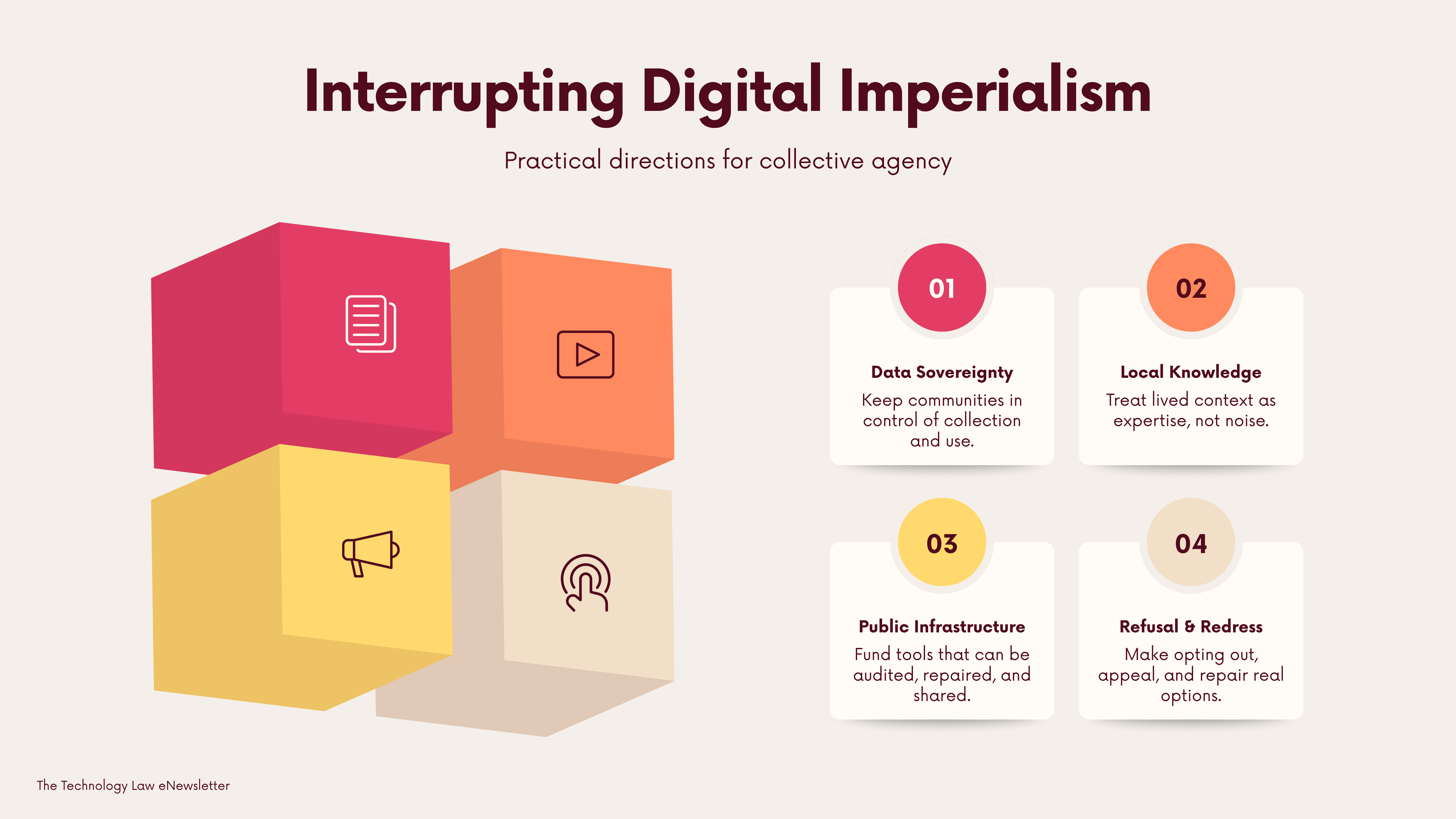
In addition, governments should distinguish location from control. A data centre within national territory may still be operated under foreign law and controlled through proprietary systems; a service hosted abroad may remain subject to enforceable privacy protections and accountable contracting.
Legal tests should therefore examine access rights, jurisdiction, security, portability and decision authority rather than equating sovereignty with server geography.
For sensitive public datasets, access controls, encryption with locally held keys, independent audit and clear limits on secondary use may provide more direct protection than a location rule alone.17
Also, there should be local capability to complement openness (i.e., capacity building). Public investment in education, research, connectivity, compute access and regional infrastructure can enable domestic firms and public institutions to participate in value creation.
Development finance and public procurement should support open standards, research partnerships and transfer of operational knowledge, while preventing “capacity building” from becoming a condition that leaves strategic control with the vendor.
The African Union’s regional approach is important here since shared standards and pooled markets may improve bargaining power more effectively than isolated national infrastructures.
Competition and sectoral regulation should focus on bottlenecks. Regulators should examine whether cloud credits, proprietary application interfaces, bundled services or restrictions on AI model access make switching practically impossible.
Remedies can include functional interoperability, access to essential interfaces, portability of data and configurations, limits on exclusivity, and merger scrutiny attentive to control of complementary assets.
These interventions should be evidence-based and proportionate.
International data governance should, at the very least, address participation as well as flows. Developing countries need a meaningful role in writing technical and legal standards, access to public-interest research and capacity to negotiate data-sharing arrangements.
The Global Digital Compact gives states a political platform for cooperation; UNCTAD’s analysis supplies a development-centred account of why flows alone do not guarantee shared benefit.18
Future negotiations should protect legitimate regulatory space, improve transparency about cross-border value chains and encourage interoperable rules that permit lawful exchange, while constraining exploitative or rights-infringing practices.
Affected communities must not disappear behind the language of national sovereignty. Community data governance, collective bargaining and benefit-sharing may be appropriate where data concern indigenous peoples, workers or local populations whose knowledge and activity produce commercial value.
Individual privacy rights remain indispensable, but consent alone is a poor instrument for negotiating structural dependency when participation in digital life is practically compulsory.
Public participation, independent oversight and accessible remedies are necessary to ensure that a state’s claim to digital sovereignty serves the people whose data and labour sustain the system.
Conclusion
Algorithmic dependency is a useful legal concept because it names a loss of practical choice that privacy and sovereignty doctrines alone do not capture.
Our “new imperialism” thesis contemplates that contemporary digital power is not colonial rule by another name, but it can reproduce extractive patterns where data, markets and labour flow outward while infrastructure, expertise and rents remain concentrated.
Our central question remains whether the conditions of data exchange preserve rights, contestability and the capacity to govern essential systems.
Existing law provides building blocks, but no complete framework exists today. Transfer rules protect persons; competition law can reduce lock-in; procurement can guarantee exit; regional and global frameworks can widen participation.
A coherent approach must connect these tools to a positive programme of capability and fair value creation and sharing.
Digital self-determination does not promise independence from all foreign systems. It requires that reliance remain chosen, reviewable and reversible, and that those who contribute to digital value have a meaningful part in shaping and sharing its benefits.
Nick Couldry and Ulises A Mejias, “Data Colonialism: Rethinking Big Data’s Relation to the Contemporary Subject” (2019) 20(4) Television & New Media 336.
UNCTAD, Digital Economy Report 2021: Cross-border Data Flows and Development: For Whom the Data Flow (UNCTAD/DER/2021) chs III, V and VI.
Aben TA, van der Valk W, Roehrich JK, Selviaridis K (2021). Managing information asymmetry in public–private relationships undergoing a digital transformation: the role of contractual and relational governance. International Journal of Operations & Production Management, Vol. 41 No. 7 pp. 1145–1191.
Park University, 2024. Leveraging Cloud Computing for Business Efficiency and Growth. [online] Park University Blog [Accessed 13 October 2026].
World Bank and International Finance Corporation, Advancing Cloud and Data Infrastructure Markets: Strategic Directions for Low- and Middle-Income Countries (2024).
ibid.
Victor, J. M. (2013). The EU general data protection regulation: Toward a property regime for protecting data privacy. Yale LJ, 123, 513.
Data Protection Commissioner v Facebook Ireland Ltd and Maximillian Schrems (Case C-311/18) EU:C:2020:559. https://eur-lex.europa.eu/legal-content/EN/TXT/?uri=CELEX:62018CJ0311.
International Covenant on Civil and Political Rights (adopted 16 December 1966, entered into force 23 March 1976) 999 UNTS 171, art 1; International Covenant on Economic, Social and Cultural Rights (adopted 16 December 1966, entered into force 3 January 1976) 993 UNTS 3, art 1.
UNGA Res 1803 (XVII), “Permanent Sovereignty over Natural Resources” (14 December 1962).
UNCTAD, Digital Economy Report 2021: Cross-border Data Flows and Development: For Whom the Data Flow (UNCTAD/DER/2021) chs III, V and VI.
Michael G Jacobides, Ioannis Lianos, Ecosystems and competition law in theory and practice, Industrial and Corporate Change, Volume 30, Issue 5, October 2021, Pages 1199–1229.
John Vickers, Competition policy and the consumer welfare standard, Journal of Antitrust Enforcement, Volume 13, Issue 1, March 2025, Pages 6–16.
McCue, C. P., Prier, E., & Swanson, D. (2015). Five dilemmas in public procurement. Journal of public procurement, 15(2), 177-207.
Regulation (EU) 2023/2854 (Data Act), arts 23–31. The Regulation entered into force in January 2024 and generally applies from 12 September 2025.
African Union Commission, African Union Data Policy Framework (2022).
Regulation (EU) 2023/2854 (Data Act), arts 23–31. The Regulation entered into force in January 2024 and generally applies from 12 September 2025.
UNGA Res 79/1, “The Pact for the Future” (22 September 2024), annex I, Global Digital Compact.