


This week’s technology law briefing examines a more uncomfortable reality about power over technology: AI, encryption, biometric identity and platform control are no longer matters that can be left to engineers, executives or general public. The discussions covered here show institutions struggling to decide who should benefit from technological progress, who should pay for its social costs and who gets to control the infrastructure through which people work, communicate, trade and prove who they are. The key observation is that technology law is becoming a test of institutional seriousness.

Newsletter Edition 99
🔥 This edition includes important updates and news in technology law from the United States, Canada, the Vatican, Costa Rica and the European Union. Access the latest opportunities, including remote jobs in technology law, conferences and events.
This Week in Technology Law:
1. The Vatican and AI: Pope Leo XIV’s encyclical Magnifica Humanitas treats AI as a tool that must protect human dignity. It warns that leaving AI governance solely to markets undermines dignity and urges public law, participation and ethical oversight.
2. Taxing AI Productivity: Senator Elizabeth Warren argues that AI success should be shared. She proposes taxing data centre energy use and closing tax loopholes to fund healthcare, education and jobs. This would reverse the current incentive that rewards automation over hiring.
3. Canada’s Bill C‑22: Apple and Meta contend Canada’s proposed Bill C‑22 could require backdoors in encryption. They say the bill’s sweeping powers could let the government force companies to break encryption and install spyware, undermining user security.
4. Pinsent Masons refers itself to the SRA for AI misuse: An Insolvency and Companies Court judge publicly admonished international law firm Pinsent Masons after a junior lawyer relied on AI to produce hallucinated legal citations and an inaccurate explanatory letter. The firm apologised and referred itself and three solicitors to the Solicitors Regulation Authority.
5. Case Note [Meta Platforms Case, 3 June 2026]: The EU General Court annulled the European Commission’s designation of Meta’s Marketplace as a gatekeeper under the Digital Markets Act because the European Commission relied on outdated data and gave insufficient reasoning. Facebook Messenger remains a gatekeeper.
Lead Story
The Vatican Warns Against Leaving AI to Market Power
On 25 May 2026, Pope Leo XIV signed his first encyclical Magnifica Humanitas. This appears to be a radical policy intervention marking the 135th anniversary of Rerum Novarum, Pope Leo XIII’s historic letter on workers’ rights during the industrial revolution.
Magnifica Humanitas approaches AI primarily as a tool and says its purpose is to protect human dignity.
The encyclical asserts that AI must serve humanity rather than allow markets and private platforms to determine its direction. To emphasise the moral continuity with the industrial era, Pope Leo compares today’s concentration of data and computing power to the nineteenth‑century concentration of capital and factories.
The document notes that major economic actors own the platforms, infrastructure and computing capacity and warns that relying on goodwill alone cannot protect dignity.
The encyclical draws a direct line between labour issues of the industrial age and today’s AI challenges. It critiques transhumanist ambitions that would surpass human limits and raises concerns about concentration of technological power. It also stresses the role of public policy in ensuring ethical governance.
According to the Vatican, AI governance is not merely a technical exercise but a moral problem requiring legal structures, public participation and courage. National laws, oversight mechanisms and public debate are essential for aligning AI with human dignity.
This message resonates because many governments still defer to market forces when regulating AI.
The Pope cautions that the same market‑centred approach that once produced harsh working conditions could now degrade human dignity through unchecked automation.


Rather than demonise technology, he emphasises that AI remains a tool and that the important question is the purpose and values guiding it.
Magnifica Humanitas provides moral authority for regulators who wish to impose fairness, transparency and accountability on AI developers.
It frames AI governance as a defence of human dignity and invites policymakers to treat AI as a public issue, rather than a purely private innovation.
Technology Law: Updates and Developments
Should AI Productivity Be Taxed?
Senator Elizabeth Warren argues that AI’s productivity gains should benefit everyone rather than a few technology investors.
She warns that AI could concentrate wealth and suggests overhauling tax rules. She notes that companies currently pay payroll taxes for workers but receive tax breaks for investing in technology, effectively penalising human labour and encouraging automation.


Senator Warren proposes raising corporate and capital‑gains taxes, closing loopholes and strengthening the minimum tax to counter this perverse incentive.
She advocates taxing AI data centres through an excise tax on their energy consumption; larger data centres would pay more.
This tax could return some AI profits to communities through investments in health care, education and jobs, ensuring that AI benefits those who support it with data, infrastructure and public research. Senator Warren also endorses a wealth tax on AI billionaires to stop them paying lower tax rates than workers.
Pinsent Masons Self‑Referral over AI‑Generated Errors
Pinsent Masons became the latest law firm embroiled in an artificial‑intelligence controversy after an Insolvency and Companies Court judge found that the firm twice misled the court in the case of Cork & Anor v Smith.
A junior lawyer, anonymised as “LA,” relied on an internal AI tool to generate legal citations and produce an explanatory letter. The first submission contained hallucinated authorities; the second compounded the errors.
Judge Mullen said the junior lawyer had “almost entirely outsourced the thinking process” to the software and that supervising solicitors Samantha Poulton and partner Steven Cottee failed to review the work properly.


Pinsent Masons apologised and reported itself and three solicitors to the Solicitors Regulation Authority (SRA).
The judge declined to initiate contempt proceedings but noted there was at least a prima facie breach of duties not to mislead the court or waste court time.
According to the judgment, the junior lawyer asked the AI to draft letters and did not verify the responses. Supervising lawyers approved a draft containing errors within hours without checking thoroughly.
Judge Mullen concluded that AI can serve as a starting point, but does not eliminate the need for critical thinking.
Apple and Google Warn Canada’s Bill C‑22 Could Threaten Encryption
Bill C‑22, currently before the Canadian House of Commons, seeks to expand “lawful access” to encrypted communications for law enforcement.
Apple and Meta argue that the bill could force companies to weaken end‑to‑end encryption or create backdoors.
Both companies fear the bill’s sweeping powers and minimal oversight could allow the government to compel them to install spyware on devices and break encryption.
Apple warns that the legislation would undermine its ability to offer privacy features and could force it to introduce systemic vulnerabilities.
Meta’s policy directors emphasise that the bill could require providers to build capabilities that break or circumvent encryption and to install government spyware directly into systems.
A spokesperson for Public Safety Canada argues that the bill does not require the creation of systemic vulnerabilities and that companies “know their systems and have a vested interest in keeping them secure”.
The objective of encryption is to protect e.g., journalists, activists, businesses and ordinary citizens from cybercrime, and weakening it could create new risks.
Legislators will need to design narrowly tailored, transparent mechanisms that respect necessity, proportionality and duration when granting access to encrypted data.
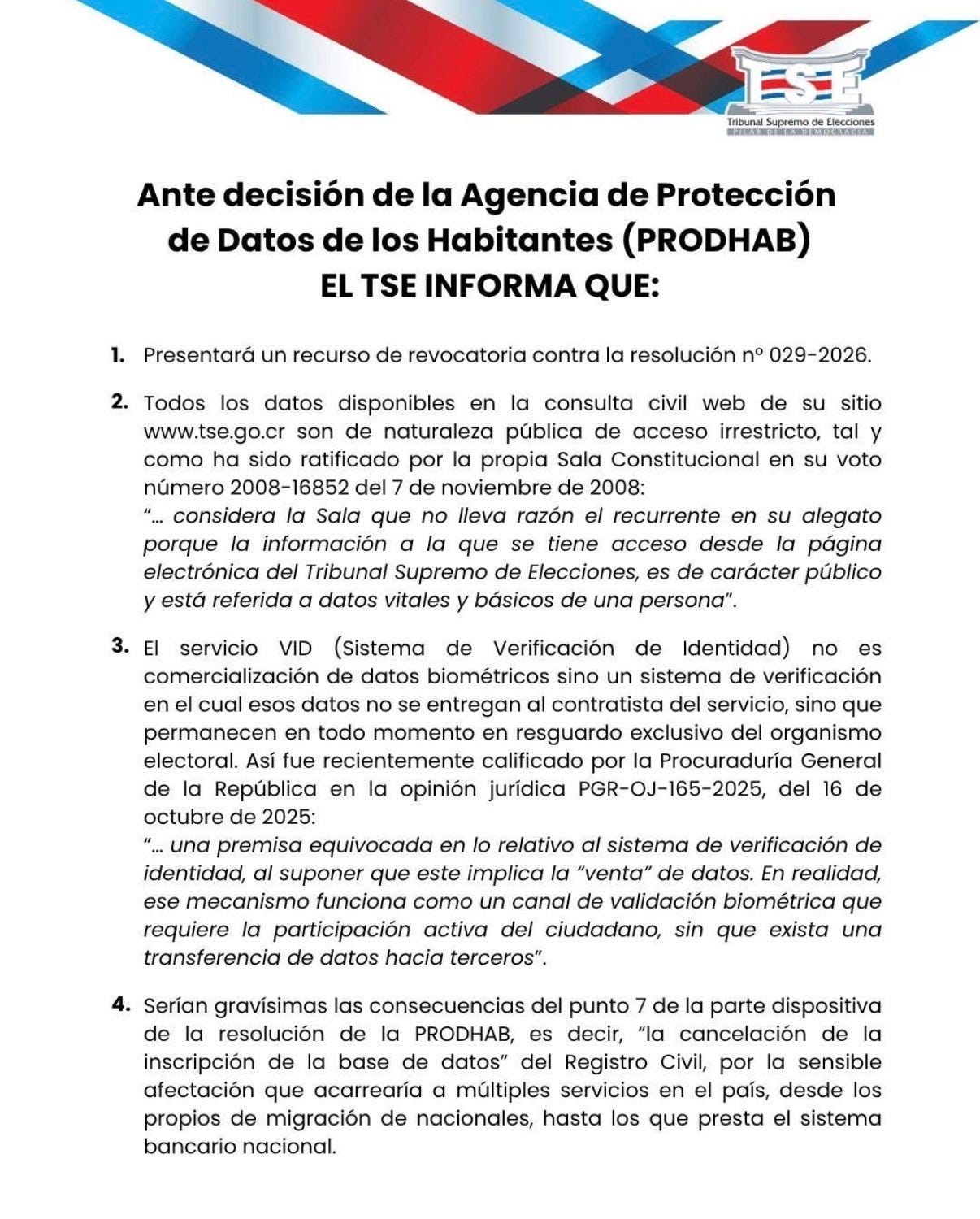
Costa Rica’s Electoral Tribunal Accused of Illegally Commercialising Biometric Data
Costa Rica’s Agency for the Protection of Inhabitants’ Data (Prodhab) has ordered the Supreme Electoral Tribunal (TSE) to stop commercialising biometric data without citizens’ informed consent.
The TSE’s Identity Verification System (VID) allows banks, businesses and public bodies to verify fingerprints and facial photographs for a fee.
Prodhab’s resolution of 4 May 2026 found that the TSE had violated the constitutional right to informational self‑determination by commercialising personal data without consent.
The agency emphasised that biometric data such as fingerprints and photographs are sensitive and that no public institution can sell them without legal authority.
The TSE has been monetising this data since 2017.
Prodhab’s order requires the TSE to obtain informed consent from citizens, update its database registration and publish information about its data processing practices. It also demands a list of data types processed and improvements to security measures within two months.
Failure to comply could lead to the cancellation of the TSE’s database registration.
The resolution sets a precedent in Costa Rica (and perhaps, globally) by explicitly classifying biometric data as sensitive and asserting that even government agencies must respect data protection law.
The TSE has not yet commented publicly on its compliance plans.
Curbing the Theft of AI Models with Export Controls
Many policymakers now see advanced artificial‑intelligence models as strategic assets comparable to sensitive defence technologies.
U.S. representatives Bill Huizenga and John Moolenaar introduced H.R. 8283, the Deterring American AI Model Theft Act of 2026, to address model theft.
According to Congressman Huizenga, state‑sponsored actors—especially in China—use “distillation” attacks to extract model weights, architectures and technical parameters from U.S. systems.
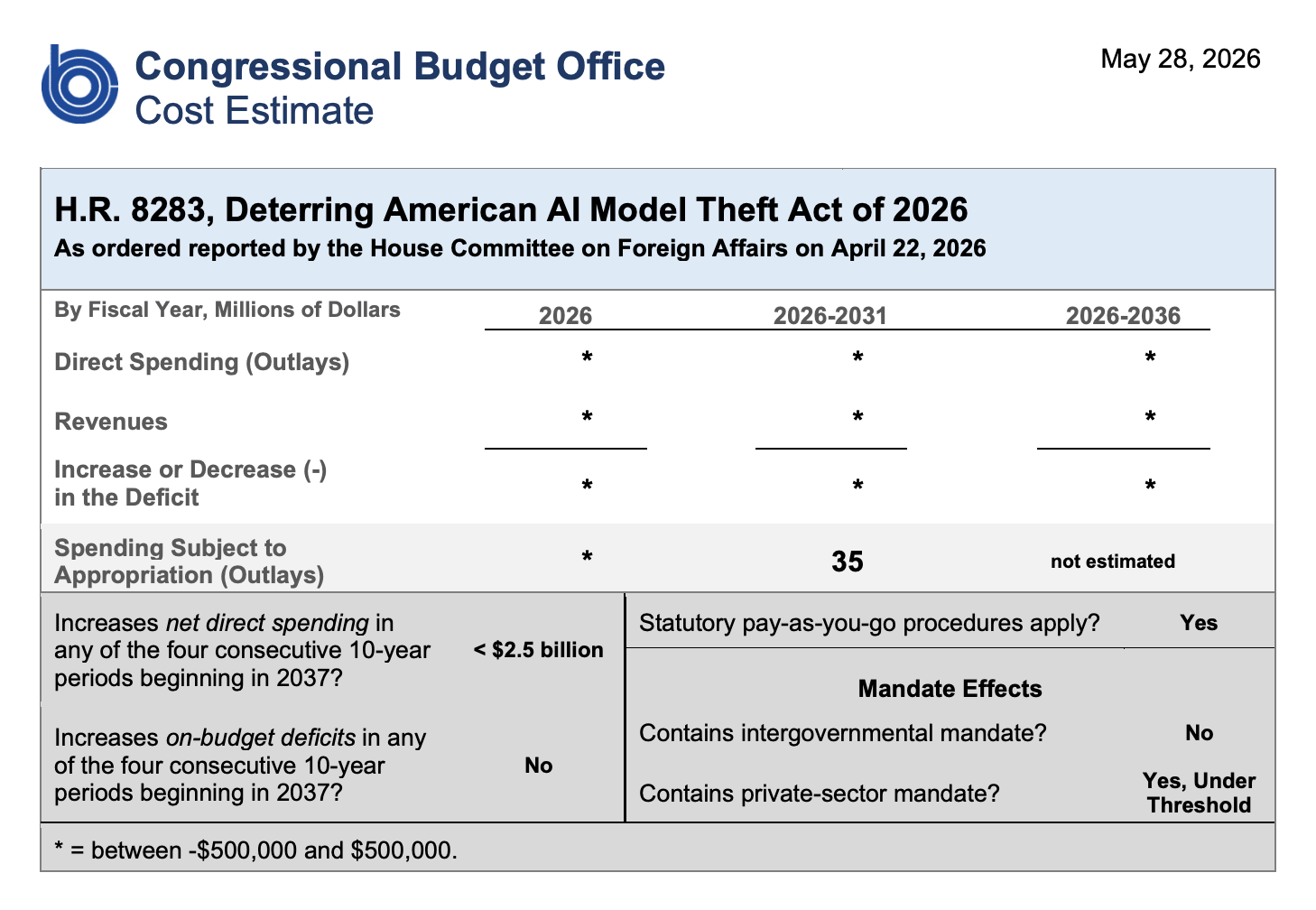
The bill would authorise discretionary sanctions, establish a “name‑and‑shame” list of foreign entities that steal AI models and facilitate public‑private threat sharing. It aims to ensure that companies and federal agencies share best practices and track attacks to strengthen defences.
The Congressional Budget Office (CBO) estimates that implementing the bill would cost about US$35 million over 2026–2031 for staffing, reporting and maintaining online platforms.
The CBO notes that federal agencies would need to identify foreign entities illicitly accessing AI models, share information with U.S. model owners and report on mitigation efforts.
The bill expands export‑control authority, allowing the U.S. government to sanction entities that illicitly access AI models. Despite the small budgetary impact, compliance may require industry participation and increase restrictions on transactions with sanctioned parties.
The underlying question is whether AI models should be treated like other export‑controlled technologies.
It can be argued that strategic AI models underpin national security and economic competitiveness, and that theft undermines the U.S. innovation ecosystem.
However, it is reasonable to believe that export controls could hamper collaborative research and global AI development. As the bill moves through Congress, expect some deeper conversations about definitions of illicit access and the balance between security and openness.
Alaska’s Privacy Bill Puts Data Brokers on Notice
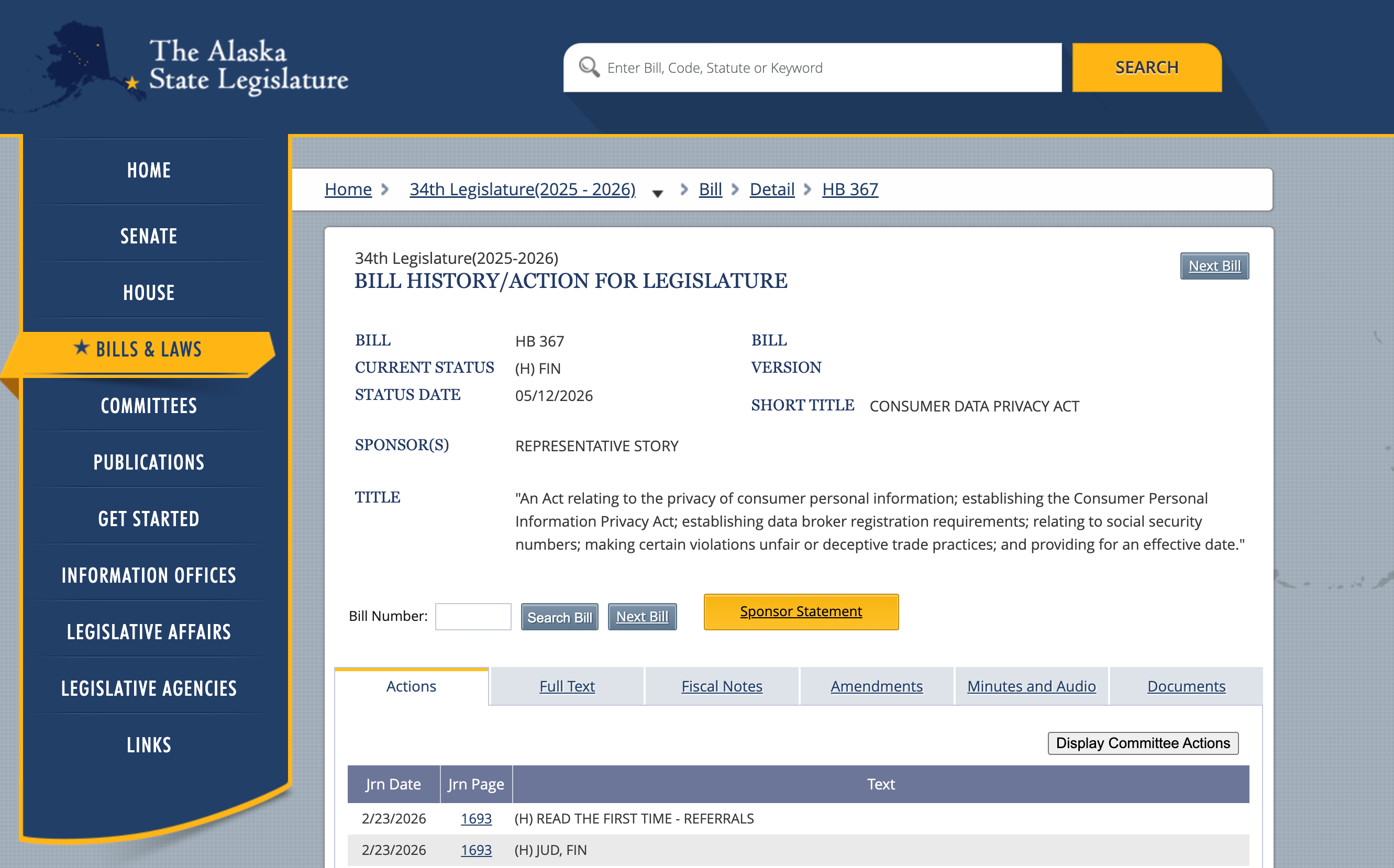
Alaska’s House Bill 367, the Consumer Data Privacy Act, represents a significant step in state privacy legislation. The bill, referred to the House Finance Committee on 12 May 2026, would grant Alaska residents rights to access, correct, delete and copy their personal data.
It applies to businesses that collected or processed data from at least 35,000 consumers during the previous year or those handling data for at least 10,000 consumers where more than 20 percent of gross revenue comes from selling personal data.
The bill excludes the federal and state governments, the University of Alaska and tribal governments.
Consumers would gain rights to confirm whether a controller is processing their data, to access and obtain a list of specific third parties to whom their data has been transferred.
They would also have the right to opt out of targeted advertising, data sales and certain profiling. Businesses subject to the bill would need to provide clear privacy notices and honour deletion and correction requests.
The bill establishes a data broker registry and treats violations as unfair or deceptive trade practices.
It is still moving through the legislative process, so amendments may modify its scope or enforcement mechanisms.
Case Note
Case: Meta Platforms v Commission
Citation: Judgment of the General Court in Case T‑1078/23 (3 June 2026)
Key Facts
Meta sought partial annulment of the Commission’s decision, contending that Messenger was not distinct from Facebook and that Marketplace did not meet the criteria for an online intermediation service.
The case raised questions about how the European Commission calculates user numbers, whether it must conduct market investigations and how it should classify services after platform modifications.
Legal Issue
Whether the European Commission lawfully designated Messenger and Marketplace as gatekeeper services under the DMA.
The court examined whether Messenger qualifies as a number‑independent interpersonal communications service, whether Marketplace is an online intermediation service and whether the Commission’s reasoning satisfied legal standards.
Legal Question Considered
Did the European Commission err in designating Messenger and Marketplace as important gateways for business users to reach end users?
Specifically, was Messenger distinct from Facebook, and did Marketplace meet the conditions to be classified as an online intermediation service under the DMA?
Was a market investigation required to verify the presumption of gatekeeper status?
Did the European Commission provide sufficient reasoning and use appropriate data when classifying Marketplace?
Definition of a gatekeeper
A gatekeeper means a very large digital platform that controls an important route between businesses and users.
Under the EU Digital Markets Act, a company can be treated as a gatekeeper when its service is so central that businesses depend on it to reach customers. In this Meta case, the European Commission said Messenger and Marketplace were “core platform services” through which business users could reach end users, therefore a gatekeeper.
Decision
The General Court upheld the European Commission’s designation of Messenger.
It confirmed that Messenger is a number‑independent communication service distinct from Facebook and that it can be used through standalone apps. Integration with Facebook does not negate its distinct functionality.
The court held that the European Commission did not err in counting all Messenger users, even those who also use Facebook, and that no market investigation was necessary because Meta’s arguments did not sufficiently rebut the presumption of gatekeeper status. The court also affirmed that Meta’s rights of defence were respected.
However, the court annulled the European Commission’s designation of Marketplace as a gatekeeper. It ruled that the Commission relied on data from the three years before the 2023 designation and failed to consider significant changes implemented in July 2023 that limited the number of listings per user.
The court found that the decision lacked concrete analysis of these changes and did not adequately demonstrate that Marketplace enabled business users to offer goods and services to consumers.
Without clear reasoning, the court could not determine whether Marketplace met the conditions for an online intermediation service.
As a result, Meta’s gatekeeper designation for Marketplace was annulled, though Messenger remains designated as a gatekeeper.
Latest Opportunities
Remote jobs in technology law
1. Regulatory Affairs Manager: Financial Crime/FinTech (Remote France), Revolut: Seeking a Regulatory Affairs Manager to support regulatory engagement in the EU. You'll be a key liaison between Revolut Bank UAB and regulators, such as the ECB (find out more).
2. General Counsel (Remote UAE), Quantum Light: Quantum Light is seeking a General Counsel to serve as the company's top legal authority and architect of our global investment platform (find out more).
3. Senior Patent Counsel (Remote US), Unified Patents: Unified Patents is again growing its legal department, and seeks to add an experienced, registered patent attorney (find out more).
4. TKYC Analyst (Remote Canada/US), Avantia: An AI-first legal and compliance services provider. As a Transaction KYC Analyst, you will work alongside asset managers’ legal, compliance, and investment teams to help bring complex private equity deals to completion (find out more).
5. Regulatory Counsel (Remote Türkiye), Binance: A leading global blockchain ecosystem behind the world’s largest cryptocurrency exchange by trading volume and registered users. Assist with legal and regulatory matters related to financial products and services in the FinTech, crypto, and blockchain sectors (find out more).
6. Product Manager (Remote Japan), BoostDraft: BoostDraft is a software engineering company that develops IDEs for documents. Currently seeking Lawyers who draft relatively standardised but long documents, such as contracts (find out more).
Conferences, fellowships, events and calls for papers
7. The Centre for Legal Education and the Legal Profession (CLELP), Westminster Law School, University of Westminster UK: Delighted to invite abstract submissions for their second annual symposium. Topics include the future legal profession: technology, innovation and change; Generative AI: legal technology and digital transformation (find out more).
8. Call for Papers on the Right to Freedom of Expression in the Digital Era: Platforms, Deepfakes, Social Media, and the Public Sphere; XVIII International Natural Law Conference: The Conference will address the status of freedom of expression in a world increasingly shaped by digital platforms, AI, synthetic media, and new forms of public and private governance (find out more).
9. Call for papers on Quantum Technology and Law, Leiden Law School: Leiden Law School invites chapters for an edited volume on quantum technology and law. Topics include legal, ethical, social, and regulatory issues linked to quantum technology. Abstracts should be 150 to 250 words, and chapters should be around 8,000 to 10,000 words (find out more).
Final Summary
This week’s developments informs us of the growing significance between moral, regulatory and strategic dimensions of technology law.
The Vatican’s encyclical reinforces the view that AI governance is more than innovation which also includes preserving human dignity.
Also, legislators are grappling with how to distribute AI’s economic benefits, secure communications and protect personal data.
Meanwhile, courts and policymakers are refining definitions of gatekeepers and strategic technologies.
The conversation is changing from whether to regulate AI and digital platforms to how to design safeguards that balance innovation, privacy and fairness.
Transparent lawmaking and robust ethical frameworks will be essential for public trust and equitable outcomes.
Leave your comments to join the conversation.
It would be interesting to see AI companies file lawsuits to resist tax laws against their companies.
Probably more theoretical than real to assume that those AI developers will listen to the words of the Pope.