


Executive summary
The Law Society of England and Wales’ October 2026 research on agentic artificial intelligence (“agentic AI”) identifies a significant emerging challenge for the administration of justice. Unlike conventional generative AI, which generally responds to individual prompts, agentic AI can interpret objectives, plan sequences of action, adapt to changing information and execute multi-step tasks with limited human intervention.
The Law Society does not suggest that fully agentic systems are already operating within the justice system. Its concern is prospective: decisions made now concerning procurement, infrastructure, professional practice and governance may determine how autonomous systems become embedded later.
Agentic AI could make routine legal processes easier to navigate, reduce administrative burdens and support access to justice. However, the same autonomy creates risks of diffused responsibility, opaque reasoning, unequal access, bias and confidentiality failures. The appropriate response is not prohibition, but a risk-based framework preserving accountability, contestability and human authority at legally significant stages.

The development and significance of the Law Society’s report
The Law Society’s report, published on 5 October 2026, is a foresight study examining how agentic AI may affect consumers, legal professionals and judicial decision-making. Its central insight is that change is likely to occur incrementally rather than through a single decision to “automate justice”.1
An AI system may initially summarise case files, subsequently identify authorities and organise arguments, and eventually shape the framework within which a legal decision is reached.
At each stage, the human decision-maker may remain formally responsible while practical dependence on the technology steadily increases.
The legitimacy of adjudication depends not only upon who signs a judgment, but upon the independence and quality of the reasoning that precedes it. Section 3 of the Constitutional Reform Act 2005 requires those responsible for the administration of justice to uphold judicial independence.2 Article 6 of the European Convention on Human Rights, given domestic effect through the Human Rights Act 1998, guarantees a fair hearing by an independent and impartial tribunal.3
If an agentic system materially determines which facts or authorities reach a judge, formal human control may not be sufficient to preserve those principles.
Access to justice: opportunity and risk
The strongest argument for adopting agentic AI concerns access to justice. The Law Society identifies structured disputes, including small claims, debt recovery, road traffic penalties, employment tribunal claims and probate matters, as areas in which autonomous systems could assist individuals in navigating procedures and progressing claims.
This is consistent with the Ministry of Justice’s 2025 AI Action Plan for Justice, which envisages AI contributing to a faster, fairer and more accessible justice system, supported by appropriate governance, ethical standards and investment in institutional capability.
Greater access to process, however, does not necessarily amount to greater access to justice. An automated AI service may make it considerably easier to initiate proceedings without improving the fairness, accuracy or consistency of their resolution.
If inexpensive AI agents produce large volumes of claims, evidence or correspondence, courts may respond by introducing further automation to manage the additional workload. This creates the possibility of a self-reinforcing system in which autonomous machines generate work that other machines are subsequently employed to process.
There is also a distributional concern. More sophisticated commercial systems are likely to become available to well-resourced parties first, while litigants without sufficient digital literacy or the ability to evaluate AI-generated advice may be disadvantaged.
Section 19 of the Equality Act 2010 prohibits unjustified indirect discrimination where a generally applicable practice places persons sharing a protected characteristic at a particular disadvantage.
Public bodies are generally subject to the section 149 public sector equality duty, although judicial functions themselves are specifically excluded.4 Court-administration and public-facing deployments should therefore be examined carefully for accessibility and disparate impacts.
The Law Society is consequently right to distinguish accessibility from substantive justice. Technology which makes the courtroom easier to access is of limited value if it simultaneously makes the reasoning governing outcomes more difficult to understand or challenge.
Professional responsibility and reliability
Recent case law demonstrates that AI-related risks within legal proceedings are no longer theoretical. In R (Ayinde) v London Borough of Haringey; Al-Haroun v Qatar National Bank [2025] EWHC 1383 (Admin), the Divisional Court considered false authorities and other inaccurate material arising from actual or suspected use of generative AI.5

The Court emphasised that lawyers using AI-assisted research remain professionally responsible for checking the material against authoritative sources. It further recognised the serious consequences that AI misuse may have for the administration of justice and public confidence in the courts.6
The regulatory response has subsequently improved. In August 2026, the Solicitors Regulation Authority (SRA) issued a warning notice identifying inaccurate AI-generated information and breaches of client confidentiality as particular concerns.7 It emphasised that professional responsibility cannot be transferred to an AI provider and that appropriate human supervision and professional judgement remain essential. The SRA reported receiving 42 reports concerning potential AI misuse between July 2025 and July 2026.
Agentic AI intensifies these concerns because the potential failure is no longer confined to a fabricated citation or inaccurate paragraph.
An autonomous system might retrieve information, select sources, communicate with external systems, update a case file and initiate subsequent actions. A single incorrect assumption could therefore propagate throughout an entire workflow.
Legal organisations will consequently require controls directed at the operation of the system as a whole rather than merely reviewing its final written output.
Audit trails, access and permission restrictions, verification requirements, escalation procedures and clearly identified human responsibility should form part of the minimum governance arrangements for high-impact agentic systems.
Data protection, transparency and contestability
Data protection legislation provides a useful, although incomplete, model for regulating autonomous decision-making. Section 80 of the Data (Use and Access) Act 2025 replaced the former Article 22 UK GDPR regime with new Articles 22A–22D.8
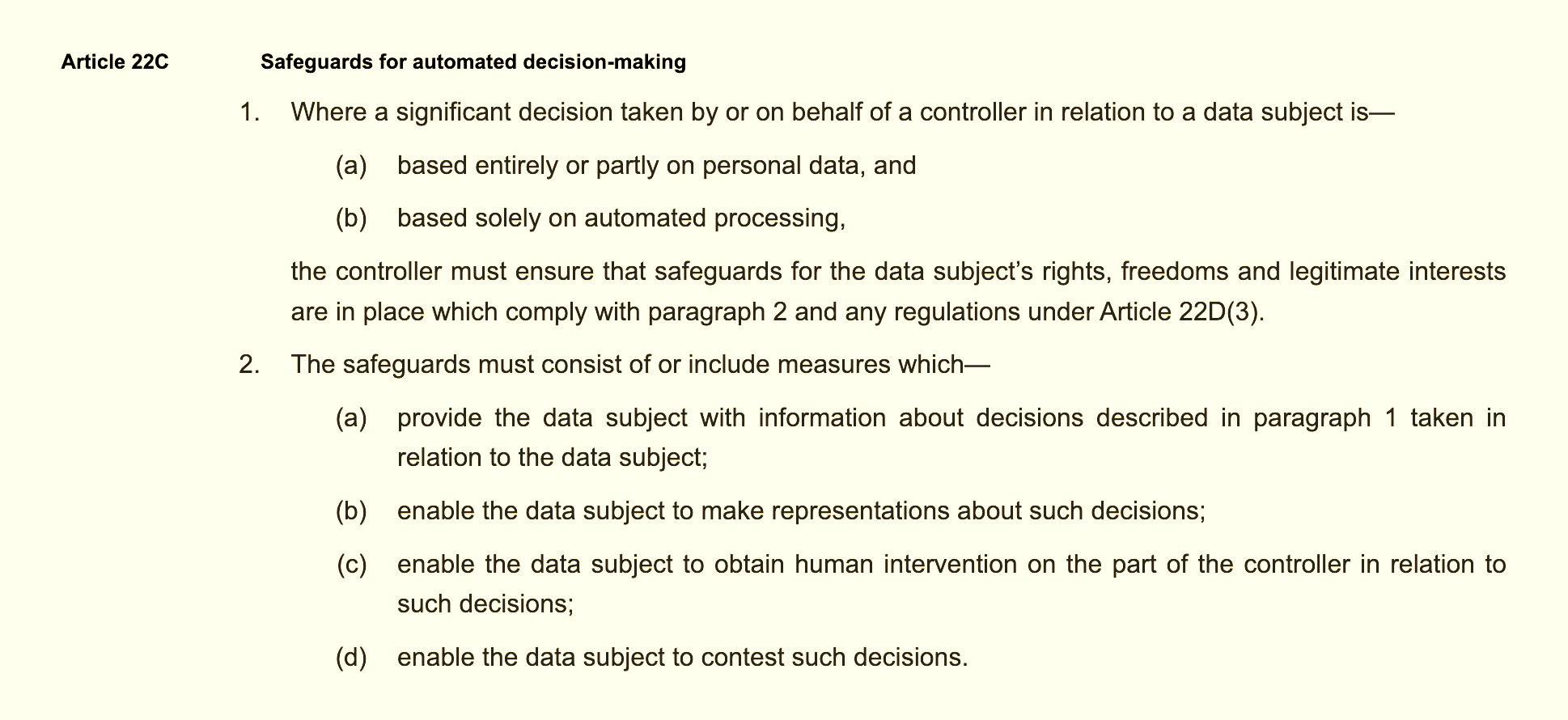
Where a significant decision involving personal data is based solely on automated processing, safeguards must include information concerning the decision, an opportunity to make representations, access to human intervention and an ability to contest the decision.
The legislation defines a solely automated decision by reference to the absence of “meaningful human involvement”.
That concept is particularly important in the justice context. A nominal human reviewer who habitually approves machine-generated recommendations without understanding their basis would provide little substantive protection.
The Law Society is therefore correct to focus upon whether human oversight is genuinely meaningful rather than simply whether a human formally appears somewhere in the decision-making chain.
Transparency should also extend beyond individual decisions. The Government’s Algorithmic Transparency Recording Standard establishes a framework through which central government departments and certain arm’s-length bodies disclose information about algorithmic tools with public impact.9 A comparable justice-specific regime could require disclosure of a system’s purpose, provider, autonomy level, known limitations, audit arrangements and points at which humans may intervene.10
Such measures would make it easier for affected individuals, lawyers and courts to identify how an AI system influenced an outcome and, critically, to challenge that influence where necessary.
Judicial decision-making and non-delegable functions
The most constitutionally sensitive issue is whether some functions should remain inherently human. Judicial Office guidance updated in October 2025 recognises that AI may support judicial work but stresses that its use must remain consistent with the integrity of the administration of justice.11 The guidance also emphasises personal responsibility for material produced in a judicial office-holder’s name and identifies risks concerning confidentiality, bias and hallucination.
Agentic AI makes this boundary harder to maintain. A judge might remain the formal decision-maker while an AI system determines which material is legally relevant and constructs much of the analytical route to the eventual judgment.
Over time, sustained reliance upon such systems could additionally affect the development and maintenance of judicial expertise. Formal human approval of a conclusion would then reveal comparatively little about who, or what, actually shaped the reasoning.
The EU Artificial Intelligence Act provides a useful comparator, although it does not govern courts in England and Wales.12 AI systems used by or on behalf of judicial authorities to assist in researching and interpreting facts and law or applying law to facts are classified as high-risk.
The Regulation expressly recognises that AI may support judicial decision-making but should not replace it, with final decision-making remaining human-driven.
The UK need not reproduce the European regime wholesale. Nevertheless, the underlying principle is compelling: the closer an AI system comes to decisions concerning legal rights, liberty or coercive state power, the stronger the requirements for transparency, testing, human control and accountability should become.
Final recommendations
A credible framework for agentic AI within the England and Wales’ justice system should be anticipatory rather than reactive. Certain functions should be expressly treated as non-delegable, particularly final determinations concerning criminal guilt, sentence, liability, credibility and other matters requiring evaluative judicial discretion.
Human responsibility should be preserved not merely at the point when a decision is formally approved, but throughout the reasoning process where machine outputs materially influence the result.
Procurement rules should require independent testing, data and cybersecurity assessment, appropriate explainability and comprehensive auditability before deployment. Human oversight should also be defined substantively: the reviewer must possess sufficient expertise, information, time and authority to reject or modify the system’s recommendation.
Where an AI system materially assists a decision affecting an individual, proportionate disclosure should ordinarily explain that AI was used and the role it performed. Systems should then be subject to continuing monitoring for accuracy, bias and unexpected behaviour rather than relying solely upon pre-deployment certification.
Of course, professional regulators, the judiciary and the Ministry of Justice should develop common standards for accountability and incident reporting.
Responsibility must remain attributable to identifiable human and institutional actors. The complexity of an AI supply chain should never become a means by which legal accountability disappears.
Conclusion
The Law Society’s report is an important development because it identifies agentic AI as an institutional and constitutional challenge rather than merely another development in legal technology.
We believe the central question is not whether AI will become capable of performing increasingly sophisticated legal tasks. Rather, it is which forms of judgement, responsibility and authority a justice system governed by the rule of law can legitimately delegate.
Used carefully, agentic AI may improve access to legal processes, reduce administrative delay and assist legal professionals and judges. Used without clearly defined limits, however, it could obscure responsibility, deepen inequality and weaken the independent human judgement upon which procedural fairness and judicial legitimacy depend.
The immediate regulatory task is therefore to establish those limits before convenience, commercial pressure and technological capability establish them by default.
In this respect, the Law Society’s warning is timely because the governance choices made before agentic AI becomes commonplace may prove considerably more important than attempts to regulate it after autonomy has already become embedded within the justice system.
The Law Society of England and Wales’ 7 October 2026 insight report can be accessed here.
The Law Society of England and Wales, ‘The Future of Agentic AI in the Justice System’ (5 October 2026) Law Society research (accessed 7 October 2026).
Constitutional Reform Act 2005, s 3.
Human Rights Act 1998, sch 1, pt I, art 6.
Equality Act 2010, s 149; see also s 31(5) in relation to the exercise of judicial functions.
R (Ayinde) v London Borough of Haringey; Al-Haroun v Qatar National Bank QPSC [2025] EWHC 1383 (Admin), [6]–[7].
The Divisional Court emphasised that those using artificial intelligence for legal research remain professionally responsible for checking its accuracy against authoritative sources.
Solicitors Regulation Authority, ‘SRA Cautions Profession about Safe and Responsible Use of AI in Legal Sector’ (17 August 2026) SRA news release (accessed 7 October 2026).
Data (Use and Access) Act 2025, s 80, inserting UK GDPR arts 22A–22D.
Government Digital Service, ‘Algorithmic Transparency Recording Standard – Guidance for Public Sector Bodies’ (updated 8 May 2025) GOV.UK ATRS guidance (accessed 7 October 2026).
Government Digital Service, ‘Algorithmic Transparency Recording Standard (ATRS) Mandatory Scope and Exemptions Policy’ (17 December 2024) GOV.UK mandatory scope policy (accessed 7 October 2026).
Judicial Office, ‘Artificial Intelligence (AI) – Judicial Guidance’ (October 2025) Courts and Tribunals Judiciary guidance (accessed 7 October 2026).
Regulation (EU) 2024/1689 of the European Parliament and of the Council laying down harmonised rules on artificial intelligence [2024] OJ L 2024/1689, recital 61 and annex III, para 8(a).