

Thomson Reuters v. ROSS Intelligence is the first federal appellate decision to rule that using copyrighted editorial material to train an AI system does not constitute fair use. ROSS copied Westlaw’s copyrighted headnotes to train a competing legal-research AI powered system, even though public-domain judicial opinions were freely available. The court held that the use was commercial, minimally transformative, unnecessarily extensive and harmful to existing and emerging markets.

Newsletter Edition 103
Thomson Reuters v ROSS Intelligence: a locus classicus
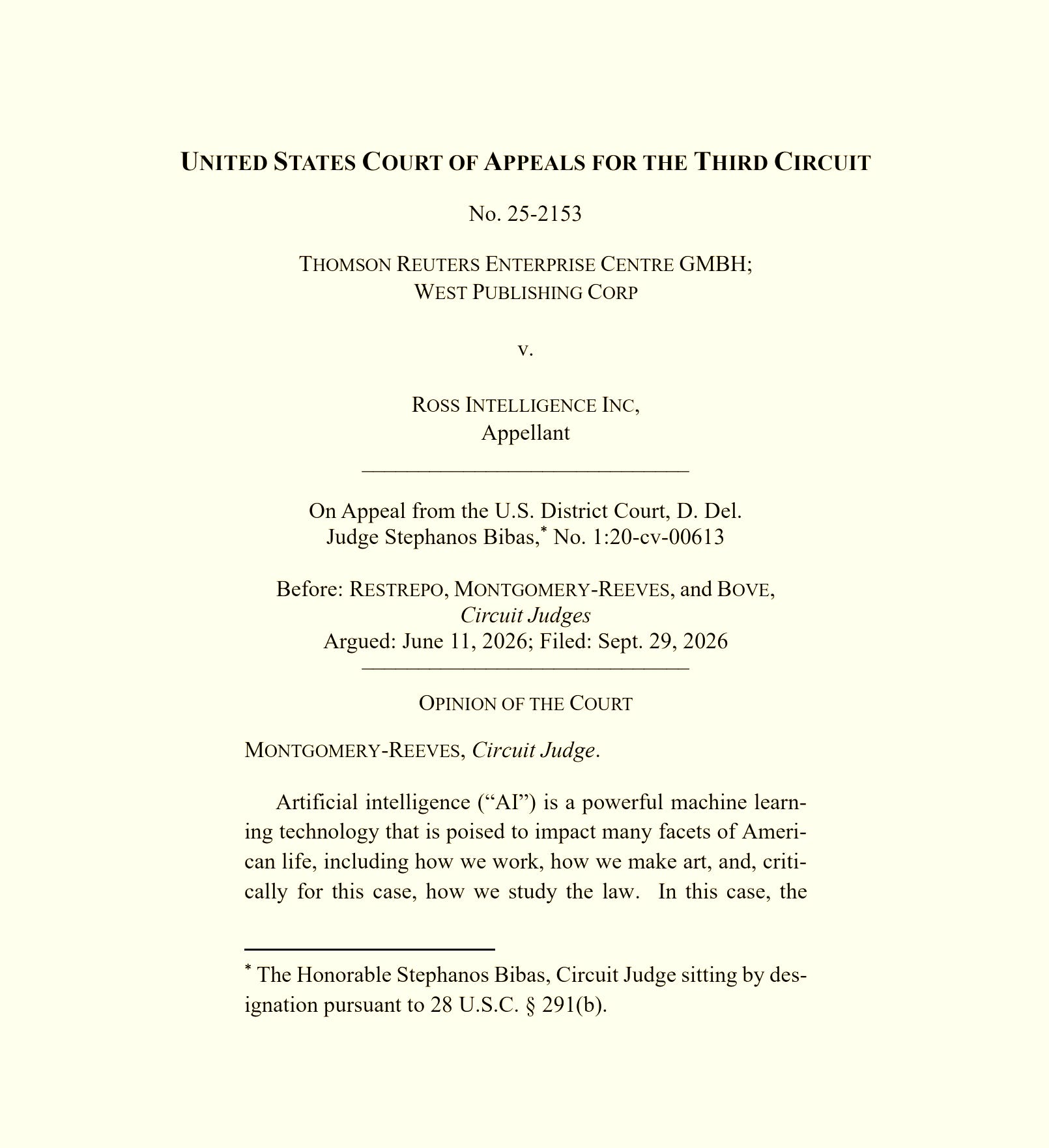
On 29 September 2026, the US Court of Appeals for the Third Circuit handed copyright owners their most important appellate victory yet in the litigation over artificial-intelligence training.
In Thomson Reuters Enterprise Centre GmbH v. ROSS Intelligence Inc., No. 25-2153, the court unanimously affirmed partial summary judgment for Thomson Reuters and West Publishing.1
ROSS had copied Westlaw headnotes, short, editor-written statements of legal propositions, to help train a rival AI legal-research service. The court held that 2,243 of those headnotes were copyrightable and that ROSS’s use was not fair use.
This is the first federal appellate decision squarely to adjudicate a fair-use defence directed at AI training.
That makes it important, but it does not establish that training AI on copyrighted works is generally infringing.
Judge Tamika Montgomery-Reeves’s opinion repeatedly stresses features that make ROSS an unusually difficult fair use case because its model was non-generative; it used the copied material for almost the same function for which Westlaw created it; the product was intended to substitute directly for Westlaw; and ROSS could have trained on freely available judicial opinions instead. The real lesson is not that “AI loses”.
It is that putting the label “training” on copying does not make the commercial purpose, the amount taken, or the market consequences disappear.
How Westlaw’s headnotes became training data
Westlaw publishes judicial opinions, which are law and therefore free for anyone to reproduce. It also adds proprietary editorial material. Its editors identify important propositions in an opinion and express them as concise, self-contained headnotes, usually in no more than 800 characters. Those headnotes help researchers understand an opinion and navigate to its relevant passages.
ROSS was developing a natural-language legal search engine. A user could ask a question and receive responsive passages from a bank of roughly ten million judicial opinions. The system did not generate fresh analysis; it retrieved existing opinion text.
To train it, ROSS commissioned LegalEase Solutions and a subcontractor to prepare approximately 25,000 “Bulk Memos”. Each memo paired a legal question with judicial passages graded from “great” to “irrelevant”.
The drafters used Westlaw headnotes to frame thousands of the questions, commonly pairing them with the passages to which Westlaw itself had linked.
ROSS had tried to license Westlaw content and been refused. Its contractors then used the headnotes because they were an “easy way” to formulate training questions.
The service was priced comparably to Westlaw, advertised against it and intended to replace it. For purposes of the appeal, ROSS no longer disputed that its contractors’ copying was attributable to it.
In February 2025, Judge Stephanos Bibas, sitting by designation in the District of Delaware, granted Thomson Reuters partial summary judgment. He found infringement as to 2,243 headnotes for which the memo questions closely tracked the headnotes rather than the underlying opinions.
The court certified originality and fair use for interlocutory appeal under 28 U.S.C. § 1292(b). ROSS forfeited its Key Number System argument, so the appeal concerned the headnotes.
Copyrightability: the law is public, the editorial work is not!
Copyright protects “original works of authorship” under 17 U.S.C. § 102(a), while § 102(b) withholds protection from ideas, systems and methods as such.2
The originality threshold is famously modest: under Feist Publications, Inc. v. Rural Telephone Service Co., a work need only be independently created and possess a minimal “creative spark”.3 The Third Circuit found that spark in the editors’ decisions about which propositions deserved a headnote and how to compress, contextualise and phrase them.
ROSS’s strongest intuition was that no private publisher should own the law. The court agreed with the premise but rejected the application. Judicial opinions remain free for all to publish under Banks v. Manchester and the government-edicts doctrine recently restated in Georgia v. Public.Resource.Org, Inc.4
But Westlaw headnotes are not judicial opinions. They are private annotations written by editors who lack authority to speak with the force of law. Indeed, Callaghan v. Myers recognised as long ago as 1888 that a reporter may claim copyright in the fruits of intellectual labour, including privately written headnotes, even though the opinions themselves are not protected.5
The merger doctrine did not change the result. It prevents copyright from monopolising an idea when that idea can be expressed in only a few ways. Here, a legal proposition could be selected and worded in many ways, as Westlaw’s and Lexis’s different headnotes illustrate. Nor did Matthew Bender & Co. v. West Publishing Co. assist ROSS: it denied protection to conventional matter such as parallel citations but described headnotes as independently composed.6
The court did not decide whether a headnote copied verbatim from an opinion could be original. The 2,243 headnotes before the court suo moto did not reproduce opinion text verbatim.
Why fair use claims failed
Section 107 of the Copyright Act directs courts to consider four non-exclusive factors.
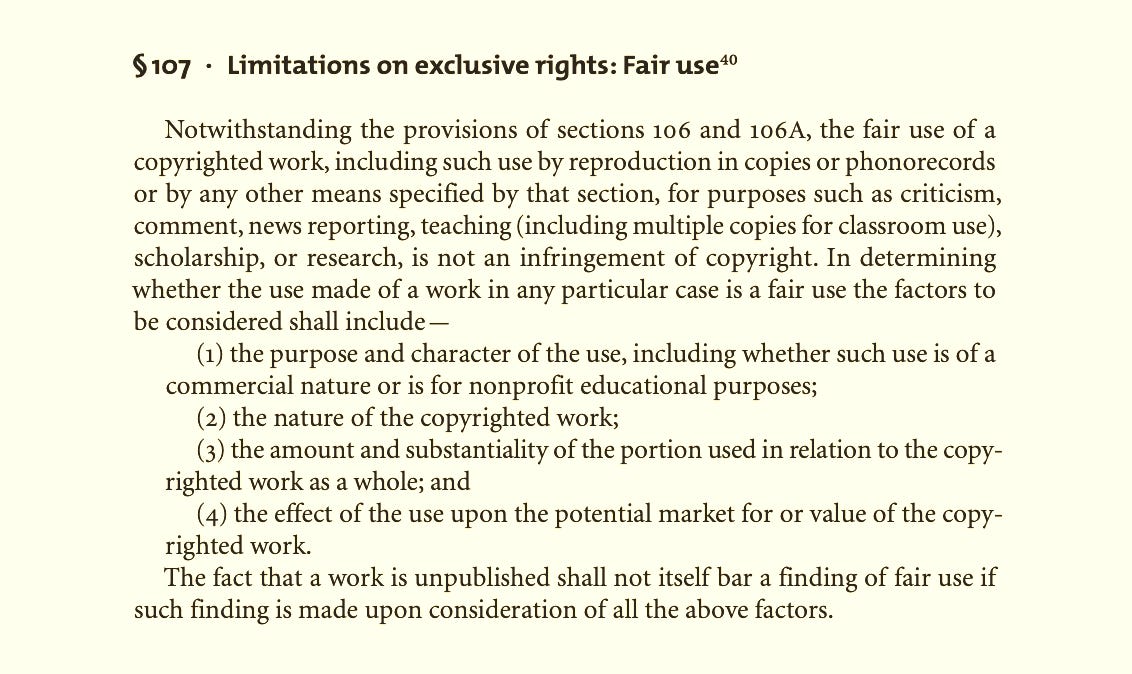
They must be weighed together in light of copyright’s constitutional purpose, not applied as a points system. ROSS bore the burden because fair use is an affirmative defence.
1. Purpose and character. This was main argument. After the Supreme Court’s decision in Andy Warhol Foundation v. Goldsmith,7 asking whether a secondary use has a “new meaning” in the abstract is not enough. Courts compare the specific purposes of the uses and pay close attention when a commercial secondary use shares the original’s purpose.
Westlaw used headnotes to help legal researchers locate and understand relevant precedent. ROSS used those same headnotes to train a commercial platform that helped legal researchers locate relevant precedent. Machine learning was an intermediate step, but it did not produce a meaningfully distinct ultimate purpose. The use was therefore “minimally transformative, at best,” and highly commercial.
That explains why Authors Guild v. Google was not considered by the court.8 Google Books copied books to create an index serving a different function and capable of directing users towards purchases. ROSS’s service did not lead users to Westlaw; it was designed to replace it.
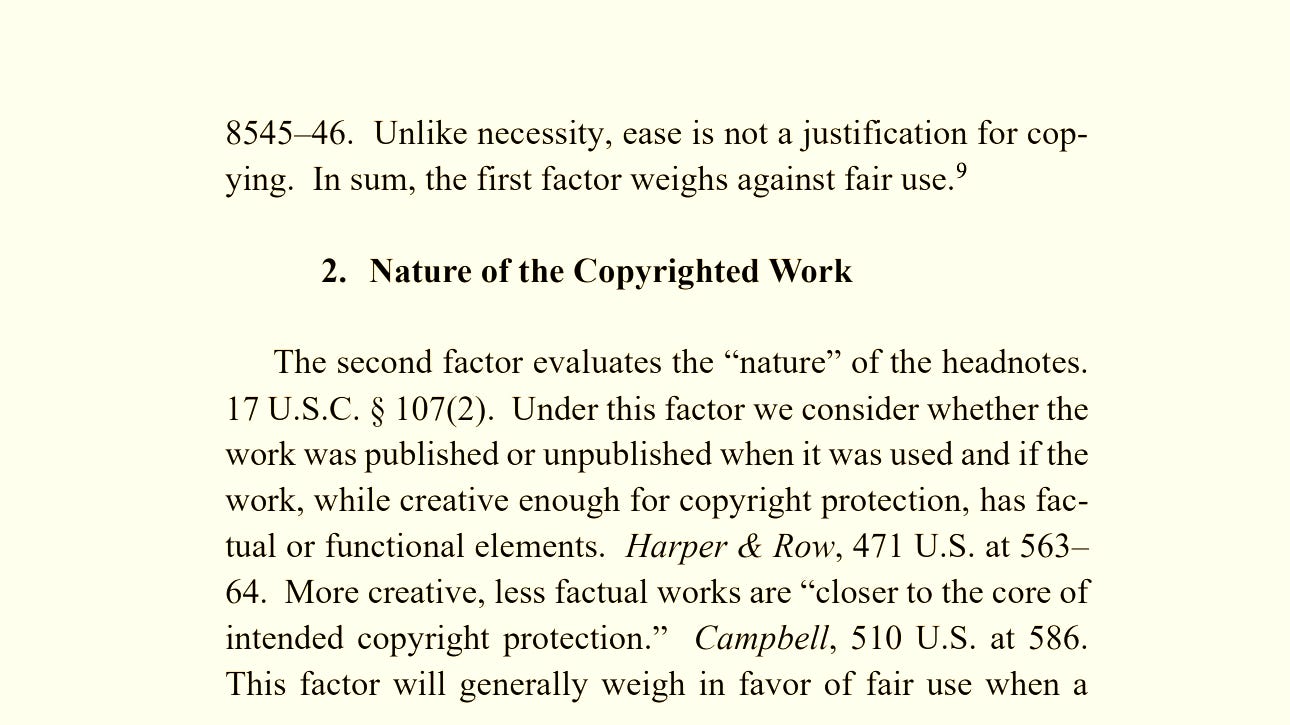
Nor could ROSS draw support from the software reverse-engineering cases such as Sega Enterprises v. Accolade, Sony v. Connectix and Google v. Oracle.9 In those cases, intermediate copying was needed to reach unprotected functional elements or achieve interoperability. ROSS was free to train its system on the underlying judicial opinions. Instead, it copied Westlaw’s protected expression because that was the easier course. The court critically analysed the distinction: “Unlike necessity, ease is not a justification for copying.”
The court also noted attempts to gain Westlaw access through credentials that concealed ROSS’s involvement. Because the Supreme Court has questioned the relevance of good faith to fair use, the point was supplemental rather than essential.
2. Nature of the work. This was ROSS’s one favourable factor. The headnotes were published and more factual than fictional because they accurately summarised law contained in unprotected opinions. The factor favoured fair use, but only slightly.
3. Amount and substantiality. ROSS argued that 25,000 headnotes were only 0.08 per cent of Westlaw’s roughly 28 million. The court rejected that position. Each headnote was itself a copyrighted work, and ROSS copied each one in full.
Because the purpose was only minimally transformative and the same training task could have been performed from public-domain opinions, taking the whole of each work was more than necessary. This is an important reminder that courts can define the “work as a whole” at the level of the individual item, not the database.
4. Market effect. The court identified three related harms.
First, even if headnotes are not sold separately, they add value to Westlaw subscriptions; ROSS appropriated that opportunity.
Second, unrestricted copying of headnotes to build substitute research platforms would harm Westlaw in the market where the two services competed.
Third, there was a developing derivative market for licensing high-quality text as AI training data. Thomson Reuters was already using headnotes to train its own AI search products. ROSS’s unlicensed copying usurped the publisher’s opportunity to exploit or license that use.
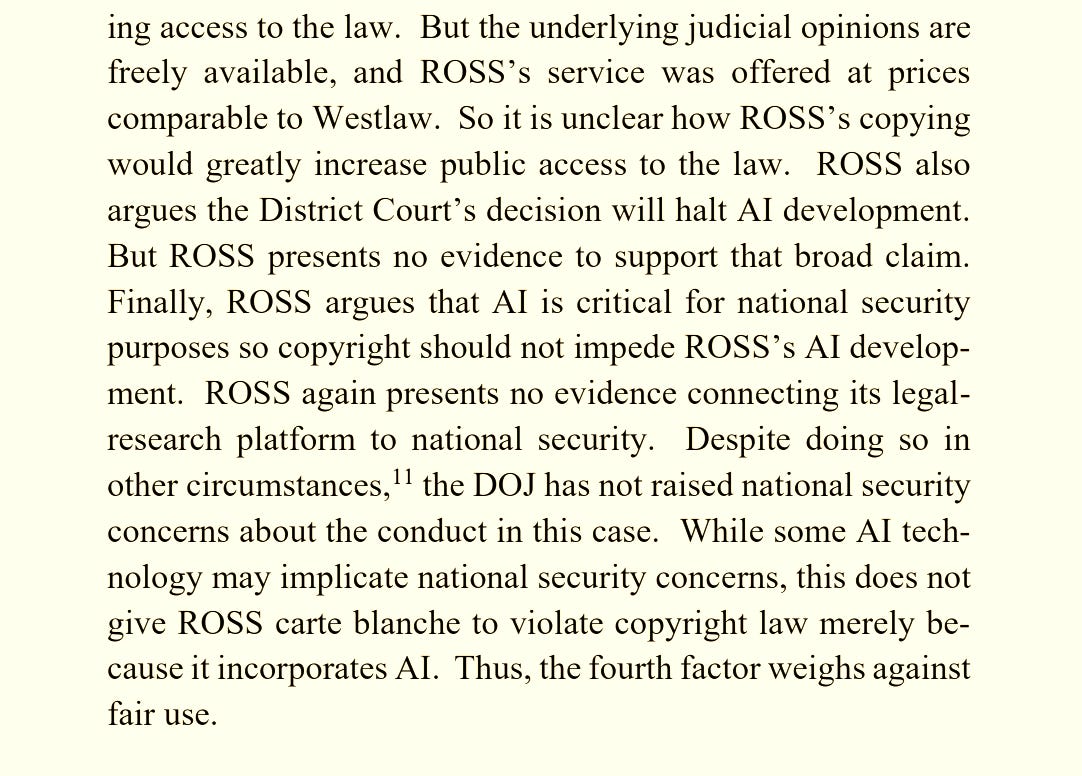
ROSS’s claimed public benefits did little to change the balance. The opinions were already freely available, ROSS charged prices comparable to Westlaw, and the record did not substantiate sweeping claims that an adverse ruling would halt AI development or impair national security.
With factors one, three and four against ROSS, the slight support from factor two could not really help the defence.
A major precedent?
Copyright owners will treat the decision as a precedent. The case confirms that organised editorial materials, including headnotes and other human-created annotations, may attract copyright protection. It also permits courts to look beyond the technical fact that copying occurred during training and examine the commercial function of the resulting system.
Under the fourth fair-use factor as we saw above, an established or realistically developing market for licensing works as training data may also be relevant.
Developers of specialised AI systems should therefore expect scrutiny of how their data were obtained, whether suitable alternatives were available, how much of each work was copied and whether the resulting product competes directly with the source from which the data were taken.
The court decision is particularly significant for search, retrieval, classification and professional-information systems trained on a competitor’s curated corpus.
Where a developer copies a competitor’s human-labelled examples to create a product that performs substantially the same commercial function, the fact that the copies were used only during training is unlikely, by itself, to establish fair use.
The court was nevertheless careful to distinguish generative AI. The models considered in Bartz v. Anthropic and Kadrey v. Meta could generate new expression; ROSS’s system could not.10 In those cases, the district courts treated the use of lawfully acquired books to train general-purpose generative models as transformative, although they differed in their treatment of pirated copies and alleged market harm.

The Third Circuit neither endorsed nor rejected that reasoning. It held only that the evidence in ROSS’s case supported a different conclusion: ROSS had used Westlaw’s editorial material to train a commercial product intended to substitute for Westlaw in the same legal-research market.
The unresolved difficulty is how courts should define the purpose of AI training while respecting copyrights.
At a narrow level, let us assume a novelist writes a book to be read, while a developer uses the book to identify statistical relationships that enable a model to produce varied responses. Framed in that way, training resembles the non-substitutive indexing function upheld in Authors Guild v. Google.
At a broader level, however, an AI model capable of producing inexpensive novels may compete with authors in the market for written entertainment.
A court could therefore characterise both activities as supplying expressive content to readers.
Warhol requires courts to consider the particular use and its commercial context, but it does not provide a mechanical rule for deciding how specifically that purpose should be defined.
The court’s treatment of the potential licensing market is also open to criticism.
Professor Mark Lemley has long warned against circular reasoning under the fourth factor in that if a copyright owner’s ability to demand payment is enough to establish a licensing market, virtually every unlicensed use could be said to cause market harm.11 The concern is especially acute in the AI context.
Recognising an exclusive market for authorising computational analysis could allow copyright owners to control uses that neither reproduce protected expression nor compete with the original works.
Lemley and Bryan Casey’s theory of “fair learning” therefore distinguishes machine learning that extracts patterns from copying that substitutes for protected expression.12
Pamela Samuelson similarly argues that courts assessing disruptive technologies should identify harms that fall within copyright’s legitimate scope, rather than treating every form of economic disruption as cognisable market harm.13
ROSS, however, presented an unusually weak case for testing the limits of that critique.
Thomson Reuters did not rely solely on the loss of a hypothetical training licence. It produced evidence that ROSS competed with Westlaw in the existing legal-research market, appropriated editorial material that helped attract Westlaw subscribers and used that material for the same kind of AI-assisted search that Thomson Reuters was itself developing.
The circularity objection will be stronger in future cases where the only asserted injury is the loss of a newly claimed licensing fee and neither the AI model nor its outputs reproduce or substitute for the copyright owner’s works.
The decision also raises a broader competition concern. Protecting curated labels and annotations rewards the costly editorial work required to create them, but it may also strengthen the position of data-rich incumbents.
Judicial opinions remain freely available, yet transforming millions of opinions into a reliable research system requires extensive human classification.
The court’s answer appears to be straightforward on that basis that copyright law protects Westlaw’s particular expression, not the underlying opinions or legal propositions, and competitors remain free to create their own annotations.
In practice, however, the cost of reproducing that editorial infrastructure may create a substantial barrier to entry and determine which firms can compete in AI-assisted legal research.
The practical rule after ROSS
The court did not create a special copyright rule for AI, nor did it hold that AI training is inherently infringing. Its approach was more orthodox. The court applied §§ 102 and 107 to the particular material ROSS copied, the purpose for which it was used, the alternatives available and the commercial markets placed at risk.
That approach gives developers a practical framework for assessing future systems. Does the training material contain protected expression, or merely unprotected facts, ideas or law? Was it obtained lawfully? Does the system put the material to a genuinely different use? Was copying the whole work reasonably necessary? Will the finished product replace or compete with the source? Is the alleged licensing market supported by evidence, or has it been asserted only after the copying occurred? And could the same objective have been achieved with public-domain or independently created material?
ROSS lost because the facts pointed consistently in one direction. It copied Westlaw’s proprietary editorial material rather than relying on the freely available judicial opinions beneath it. It reproduced entire headnotes, chose convenience over necessity and used the resulting system to compete with Thomson Reuters in the same legal-research market.
Thomson Reuters Enterprise Centre GmbH v. ROSS Intelligence Inc., No. 25-2153 (3d Cir. filed Sept. 29, 2026).
Feist Publications, Inc. v. Rural Telephone Service Co., 499 U.S. 340 (1991).
Georgia v. Public.Resource.Org, Inc., 590 U.S. 255 (2020).
Callaghan v. Myers, 128 U.S. 617 (1888).
Andy Warhol Foundation for the Visual Arts, Inc. v. Goldsmith, 598 U.S. 508 (2023); Google LLC v. Oracle America, Inc., 593 U.S. 1 (2021); Campbell v. Acuff-Rose Music, Inc., 510 U.S. 569 (1994); Harper & Row, Publishers, Inc. v. Nation Enterprises, 471 U.S. 539 (1985); Banks v. Manchester, 128 U.S. 244 (1888).
Andy Warhol Foundation for the Visual Arts, Inc. v. Goldsmith, 598 U.S. 508 (2023).
Authors Guild v. Google, Inc., 804 F.3d 202 (2d Cir. 2015); Authors Guild, Inc. v. HathiTrust, 755 F.3d 87 (2d Cir. 2014).
Sony Computer Entertainment, Inc. v. Connectix Corp., 203 F.3d 596 (9th Cir. 2000); Matthew Bender & Co. v. West Publishing Co., 158 F.3d 674 (2d Cir. 1998); Sega Enterprises Ltd. v. Accolade, Inc., 977 F.2d 1510 (9th Cir. 1992).
Bartz v. Anthropic PBC, 787 F. Supp. 3d 1007 (N.D. Cal. 2025); Kadrey v. Meta Platforms, Inc., 788 F. Supp. 3d 1026 (N.D. Cal. 2025).
Mark A. Lemley & Bryan Casey, “Fair Learning,” 99 Texas Law Review 743 (2021).
Mark A. Lemley, “Should a Licensing Market Require Licensing?,” 70 Law and Contemporary Problems 185 (2007); Barbara Bruni, “Training on Trial: Insights from Bartz and Kadrey,” 73 Journal of the Copyright Society 263 (2026).
Pamela Samuelson, “Fair Use Defenses in Disruptive Technology Cases,” 71 UCLA Law Review 1110 (2024).
This ruling seems pretty significant in the grand scheme of things for companies that depend on data aggregation machine learning from external sources.