


Case Summary
Thomson Reuters v. ROSS Intelligence is the first federal appellate decision to rule that using copyrighted editorial material to train an AI system does not constitute fair use. ROSS copied Westlaw’s copyrighted headnotes to train a competing legal-research AI powered system, even though public-domain judicial opinions were freely available. The court held that the use was commercial, minimally transformative, unnecessarily extensive and harmful to existing and emerging markets.
Thomson Reuters v ROSS Intelligence: a locus classicus
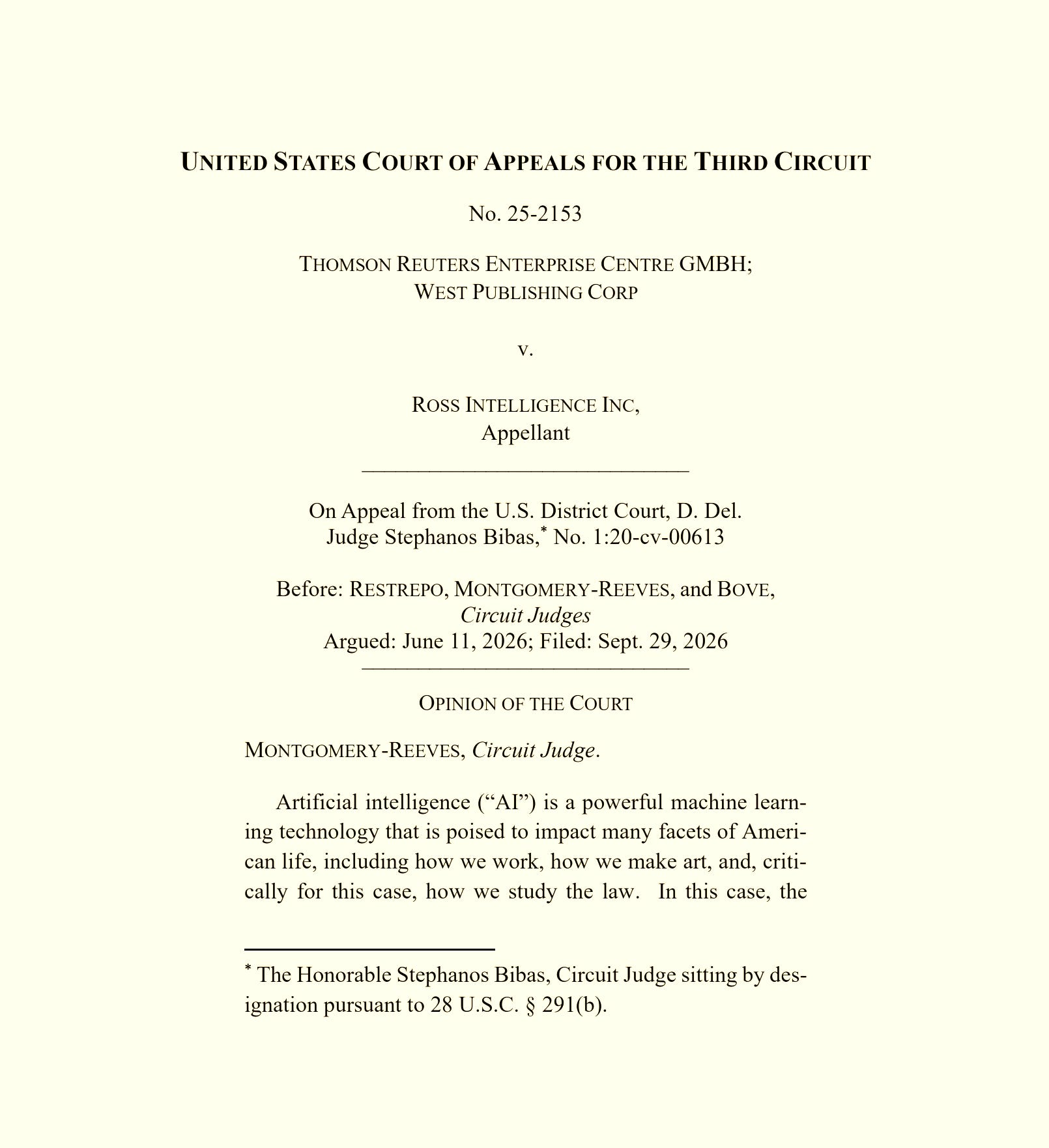
On 29 September 2026, the US Court of Appeals for the Third Circuit handed copyright owners their most important appellate victory yet in the litigation over artificial-intelligence training.
In Thomson Reuters Enterprise Centre GmbH v. ROSS Intelligence Inc., No. 25-2153, the court unanimously affirmed partial summary judgment for Thomson Reuters and West Publishing.1
ROSS had copied Westlaw headnotes, short, editor-written statements of legal propositions, to help train a rival AI legal-research service. The court held that 2,243 of those headnotes were copyrightable and that ROSS’s use was not fair use.
This is the first federal appellate decision squarely to adjudicate a fair-use defence directed at AI training.